




Does a Supermarket Stockroom Need a Self-Repairing High-Speed Door
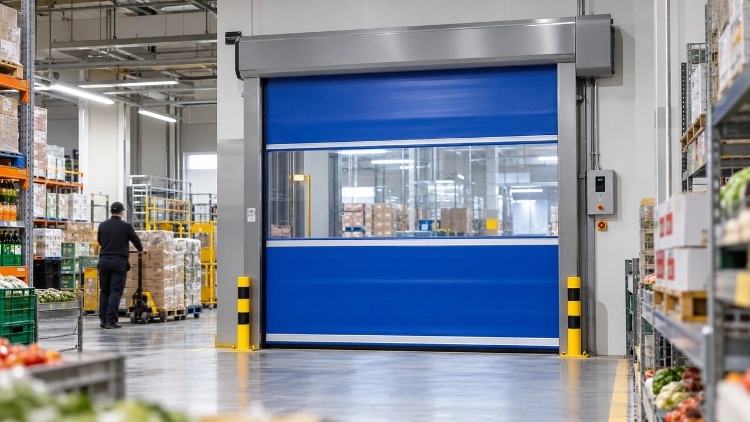
A supermarket stockroom has a different traffic pattern from a public entrance. Staff move roll cages, pallet trucks, carts, and sometimes forklifts through the same opening while replenishment work continues around them. In that setting, a high speed door is not selected only for fast opening. The more important question is what happens after a cart or vehicle clips the curtain or guide during a busy shift.
A self-repairing supermarket high-speed door can be useful when minor impacts are likely and the opening cannot stay out of service for long. If traffic is mainly pedestrian, the route is wide, and collisions are rare, a standard rapid door may already be adequate. The choice therefore depends on traffic type, impact risk, environmental separation, and the cost of interruption rather than on speed alone.
When Does Self-Recovery Become Worth Paying For?
The first step is to look at how the stockroom actually operates. A backroom door that opens only for staff and small hand carts has a very different duty from a replenishment route used by pallet trucks throughout the day. The self-repairing feature becomes more valuable as the chance and consequence of side impact increase.
A practical review should consider four points. How many movements pass through the opening during the busiest hours? What proportion of that traffic is made up of carts, pallet trucks, or forklifts rather than people? How much clearance do drivers have on each side of the opening? What happens to the operation if the curtain leaves the guide and the door cannot close?
For a low-risk internal doorway, the answer may be simple: a standard pvc high speed door can separate spaces efficiently without adding a feature that the site rarely needs. For a stockroom where trolleys turn sharply near the opening or drivers approach with limited visibility, the cost of repeated manual resetting can become more important than the initial difference between door types.
Self-recovery should therefore be treated as a downtime-control feature. It is not automatically the better choice for every supermarket. It earns its place where traffic conditions make light impacts reasonably foreseeable.
What Actually Happens When the Curtain Is Hit?
A self-repairing design uses a flexible curtain and a zipper-type guide arrangement rather than relying only on a rigid curtain edge. If the curtain is pushed out of the track by a suitable impact, the system is designed so the curtain can return to the guide during the next opening movement. The purpose is to keep a minor collision from becoming a long service interruption.
GUDESEN’s Self-Recovery Rapid Door uses pvc fabric, an adjustable operating speed of 0.5-1.5 m/s, a full-perimeter tight seal, and a servo control system. Safety photoelectric protection is included as standard in GUDESEN’s quick-door configuration. Those details matter in a supermarket backroom because the door may cycle frequently while people and goods share the same passage.
The self-recovery function should not be confused with immunity to damage. A severe strike can still affect guides, the bottom structure, sensors, or surrounding building work. The feature is intended to reduce disruption after minor derailment events, not to make the opening collision-proof.
That distinction is important for buyers. If a route has repeated hard impacts, the problem may be poor traffic geometry, insufficient protection, or the wrong door type rather than a lack of self-repair capability.
When Is a Standard High-Speed Door Still Enough?
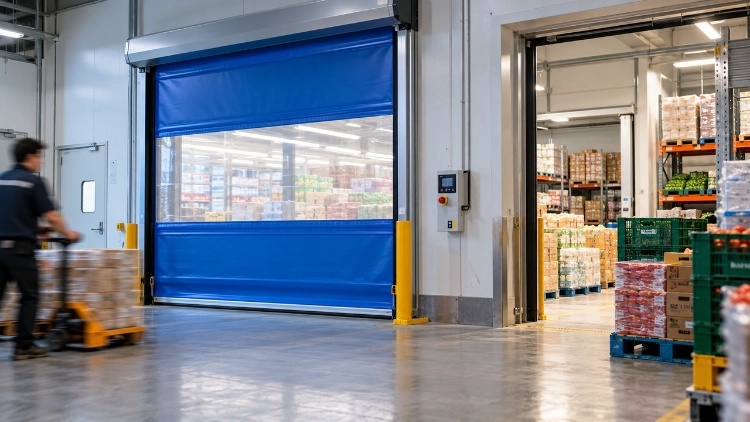
A standard rapid door can still be the more rational choice when the opening has predictable traffic and limited collision exposure. For example, a doorway between two stock areas may mainly serve employees pushing light carts along a straight route. If there is generous side clearance and the door is visible well before people reach it, accidental contact may be uncommon.
The decision should also reflect the main job of the opening. If the priority is quick separation between indoor zones, dust control, or reduced air exchange, a conventional high speed door may meet the requirement without the added self-recovery structure. A buyer should not pay for an impact-management feature merely because the term sounds more advanced.
By contrast, the case for a self-repairing door becomes stronger where carts approach from an angle, operators turn close to the jamb, goods can obstruct sight lines, or the door serves a route that cannot be closed for manual repair. Supermarket stockrooms often combine several of these conditions, especially near receiving and replenishment areas.
Which Activation and Safety Setup Fits the Backroom?
Door type is only one part of the specification. The opening method should match the traffic that approaches the door, and the safety system should reflect the mix of people and equipment.
Vehicle-Heavy Traffic
Where forklifts or other metal vehicles make up a large share of the traffic, geomagnetic induction can be a suitable activation method. It can trigger the door when a vehicle enters the detection zone, reducing the need for a driver to stop and use a wall switch. This is particularly useful where operators need both hands to control the vehicle or load.
People and Cart Traffic
For passages used mainly by people, radar or a push button can be more appropriate. Radar offers hands-free opening where workers are carrying goods or pushing carts, while a button can be useful where the operator should make a deliberate opening command.
Safety protection is separate from activation. A photocell watches the closing path and can stop or reverse the door when its beam is interrupted. A light curtain adds a larger monitored area and can be considered where people, carts, and goods frequently overlap near the threshold. A bottom safety edge or airbag may provide another layer on suitable configurations.
Where Should a Supermarket Not Use This Door Type?
A self-repairing zipper door is often strongest as an internal traffic door. It should not be selected automatically for every exterior supermarket opening.
If an opening is exposed to significant wind, requires strong anti-theft performance, or acts as the main external security barrier, a rigid door may be more suitable. High speed stacking doors, simple hard fast doors, and turbine hard fast doors serve different combinations of wind resistance, security, speed, and exterior exposure.
This matters because a stockroom project can contain several door duties within a short distance. The receiving entrance may need a rigid exterior barrier, while the internal route between receiving and storage may benefit from a self-repairing rapid door. Treating both openings as one problem can lead to the wrong specification.
Temperature also changes the choice. A supermarket freezer or chilled room may need insulation, anti-freeze details, or a dedicated cold-storage high speed door rather than a standard single-layer zipper curtain. The traffic pattern may be similar, but the thermal requirement is not.
What Should Be Included in the RFQ?
A useful request for quotation should give the manufacturer enough information to review the whole opening, not just width and height. The basic dimensions are necessary, but they do not show how the door will work during a normal shift.
Start with the clear opening width and height, then state whether the door is internal or external. Describe the traffic mix, including people, trolleys, pallet trucks, forklifts, or other vehicles. If the opening already exists, note any history of curtain or guide impacts. Estimated daily cycles are also useful because a heavily used replenishment route places different demands on the drive system from an occasional stockroom door.
The RFQ should also identify the required activation method, available headroom and side room, the temperature on each side of the opening, and any need for enhanced safety protection. If security after hours is important, say so explicitly. That point may change the recommended door type.
GUDESEN commonly configures rapid-door systems with servo drive, multiple activation options, and safety devices, but the final selection should match the site rather than follow one fixed package. Buyers can use the GUDESEN industrial door range to compare rapid, rigid, insulated, and roller-shutter options before fixing the specification.
Conclusion
A self-repairing supermarket high-speed door makes the most sense when the opening combines frequent traffic, wheeled equipment, limited maneuvering space, and a low tolerance for downtime after minor impacts. Its main value is not simply faster movement. It is the ability to restore the curtain after suitable derailment events without turning every light collision into a maintenance stoppage.
For calmer internal routes, a standard rapid door may be sufficient. For exposed or security-critical openings, a rigid solution may be more appropriate. The specification should follow the traffic pattern, environment, and operational consequence of failure.
For a broader comparison of door options in busy retail logistics, see Which Are the Best Warehouse Speed Doors for High-Traffic Supermarkets in 2026?. That article covers the wider supermarket door-selection question, while this one focuses on when self-recovery is justified.
If the site team can provide the opening size, traffic mix, cycle frequency, and temperature conditions, request a configuration review before the final RFQ is issued.
FAQs
Q: Can a self-repairing high-speed door reset after a cart or forklift impact?
A: It can reset after suitable minor derailment events when the flexible curtain is pushed out of the zipper-type guide. During the next opening movement, the curtain can return to the track. A severe collision can still damage other parts of the door or surrounding structure, so self-recovery should not be treated as complete impact protection.
Q: Are self-repairing high-speed doors suitable for exterior supermarket entrances?
A: Not automatically. Exterior openings may place greater demands on wind resistance, anti-theft protection, weather exposure, and structural rigidity. A rigid high speed door, stacking door, or other exterior-rated solution may be more appropriate depending on the site.
Q: Which sensor is better for supermarket stockroom traffic?
A: The answer depends on who uses the route. Geomagnetic induction can suit vehicle-heavy traffic, while radar or push-button activation can suit pedestrian and cart traffic. Safety devices such as photocells or light curtains should be specified separately from the activation method.