




Cold Storage Door and Freezer Door Requirements for High-Traffic Entrances
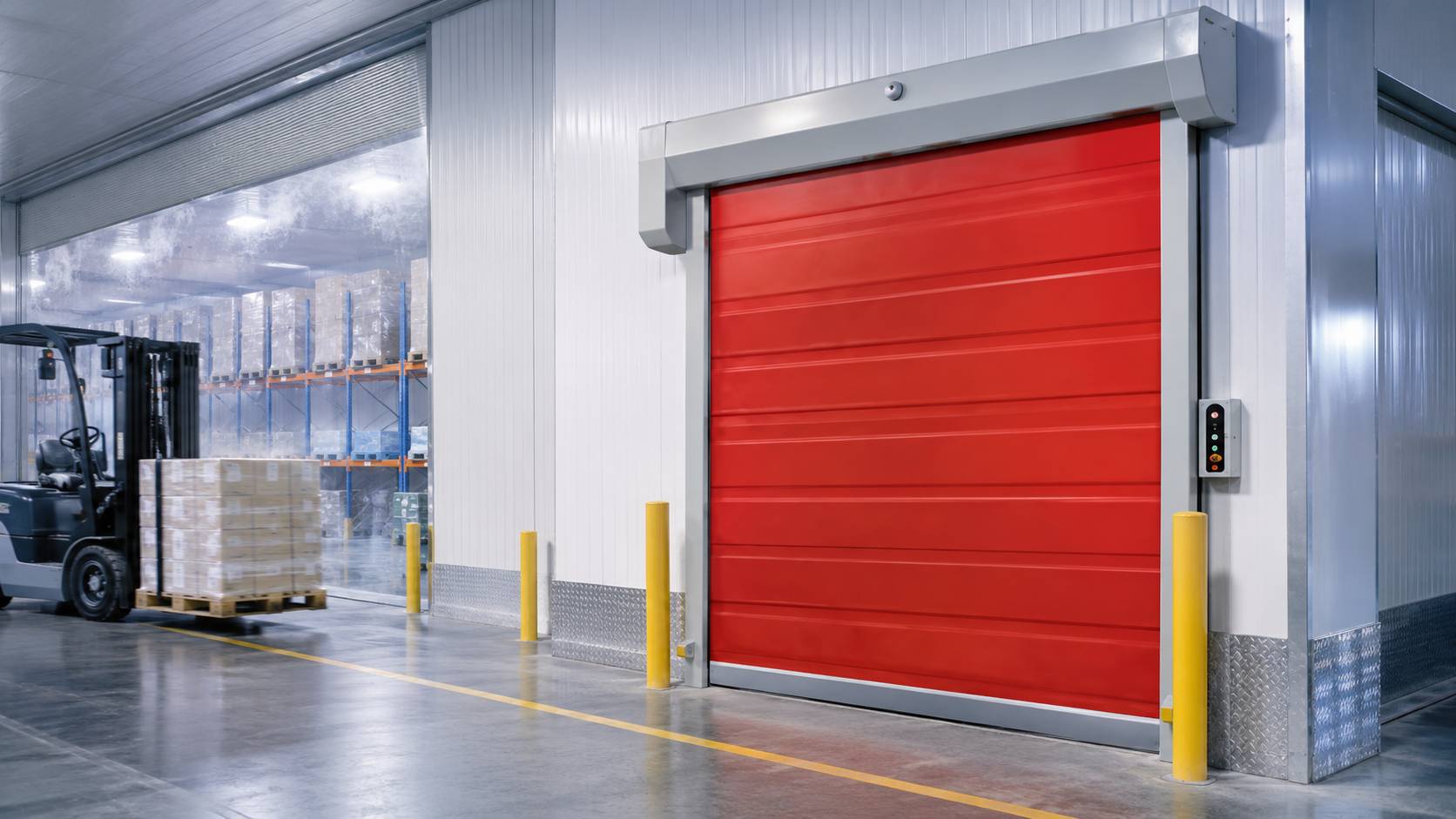
A refrigerated entrance must protect temperature while allowing forklifts, pallet trucks, and personnel to pass without delay. These operating requirements can pull the specification in different directions. Better insulation improves the closed barrier, while fast movement limits air exchange during passage. The right specification therefore depends on temperature difference, traffic, opening size, sealing, frost risk, and control method rather than on the curtain alone.
A cold storage door between a chilled warehouse and a loading area may face moderate temperature changes and steady pallet traffic. A freezer door serving a lower-temperature room may also face condensation, frost, and more demanding operating conditions. Both require a project-specific review before drawings, controls, and safety devices are approved.
For a high-traffic refrigerated entrance, the main requirements are suitable insulation, continuous perimeter sealing, reliable low-temperature operation, traffic-matched activation, and independent closing-safety detection.
Define the Temperature Zone and Traffic Duty First
Door selection should begin with the real conditions on both sides of the opening. Two entrances with the same dimensions may require different configurations when one serves a chilled dispatch zone and the other serves frozen storage.
Record the Temperature and Humidity Conditions
The project brief should state the normal internal setpoint, the expected temperature outside the room, and the largest temperature difference during operation. Humidity matters because warm air entering a colder space can create condensation near the threshold, guides, or sensors.
Seasonal changes and cleaning routines should also be considered. A doorway may remain dry during an initial site survey but face moisture once refrigeration, washdown, and daily traffic begin.
Measure Forklift and Personnel Traffic
Traffic should be described by actual operating patterns rather than a general label such as heavy use. Useful details include movements during the busiest hour, whether forklifts queue near the opening, whether people share the lane, and whether vehicles stop under the curtain.
Forklift mast height and load height determine the required clear opening. Mixed traffic also changes sensor planning because a vehicle activation signal does not protect a person or pallet remaining inside the doorway.
Confirm the Opening and Installation Space
Measure clear width and height at several points, then record the space above and beside the opening. The guides, drive, cover, control box, and service area all need room. Pipes, racks, evaporator equipment, or guardrails may restrict installation.
The floor also needs attention. A sloped, cracked, or uneven surface can leave a gap under the bottom seal. Photographs from both sides of the opening can help identify potential conflicts before production drawings are prepared.
Match the Door Construction to the Temperature Requirement
Thermal separation depends on the curtain, side retention, top area, and bottom contact working together. A well-insulated curtain alone cannot fully compensate for poor guide alignment or an uneven threshold.
Three-Layer Curtain Construction Supports Thermal Separation and Durability
The insulated curtain uses a three-layer sandwich structure. PVC Coated Polyester Fabric (Low Temperature Resistant) forms the high-density industrial outer layers, while two aluminum-film layers and thermal insulation cotton form the insulation core. This construction combines thermal separation with the durability required for frequent opening and closing.
The final curtain build should match the room temperature, opening size, cycle frequency, and cleaning conditions. Buyers should confirm the complete material structure rather than assuming that all insulated curtains provide the same low-temperature performance.
Zipper and Guide Structures Affect Side Sealing
Side sealing depends on the relationship between the curtain edge and the guide system. A zipper structure can retain the curtain and reduce uncontrolled gaps. Polymer track components, aluminum guide elements, and a POM steel zipper may be combined to support movement and sealing.
Alignment remains critical. Guides that are not parallel can cause uneven travel and inconsistent sealing contact. They also need protection from forklift impact without blocking service access.
Bottom and Perimeter Seals Complete the Barrier
The bottom edge must follow the finished floor without creating excessive drag. Effective bottom sealing depends on close contact between the curtain edge and the floor, while ice, debris, damaged concrete, or an uneven surface can still create leakage paths.
A closed-door inspection should cover the top, both sides, and the floor contact. Checking only whether the curtain reaches the ground can miss gaps along the guides or header.
Check Frost Control and Low-Temperature Reliability
Low-temperature reliability depends on where moisture enters, where the coldest surfaces occur, and how the entrance is maintained. Frost risk should be reviewed before the guide, sensor, and electrical configuration is finalized.
Identify Likely Frost Locations
Common concern areas include the guide path, curtain edges, bottom seal, floor beside the opening, and exposed sensor faces. Frequent opening can bring moisture into these locations even when the room itself is well controlled.
The site review should look for airflow paths and places where water can remain after cleaning. Identifying the likely frost locations is more useful than applying the same treatment to every part of the entrance.
Track Antifreeze Protection Supports Freezer-Area Operation
For freezer-area installations, the guide track includes an antifreeze device that helps reduce ice buildup and supports reliable curtain movement under low-temperature conditions. This feature is especially relevant where humid air enters the opening and increases the risk of freezing along the track.
The project team should confirm the device’s power supply, control method, cable routing, and service access before the guide system and electrical layout are finalized.
Verify Sensors Under Condensation Conditions
Infrared devices need a clear detection path. Condensation, frost, dirt, or misalignment can affect operation near a cold threshold. Commissioning should take place after the room reaches realistic temperature and humidity conditions.
Testing should include stopped vehicles, projecting pallet loads, and personnel walking behind a forklift. A dry test in an unfinished building does not represent the entrance’s final operating environment.
Select the Opening Method Around the Traffic Pattern
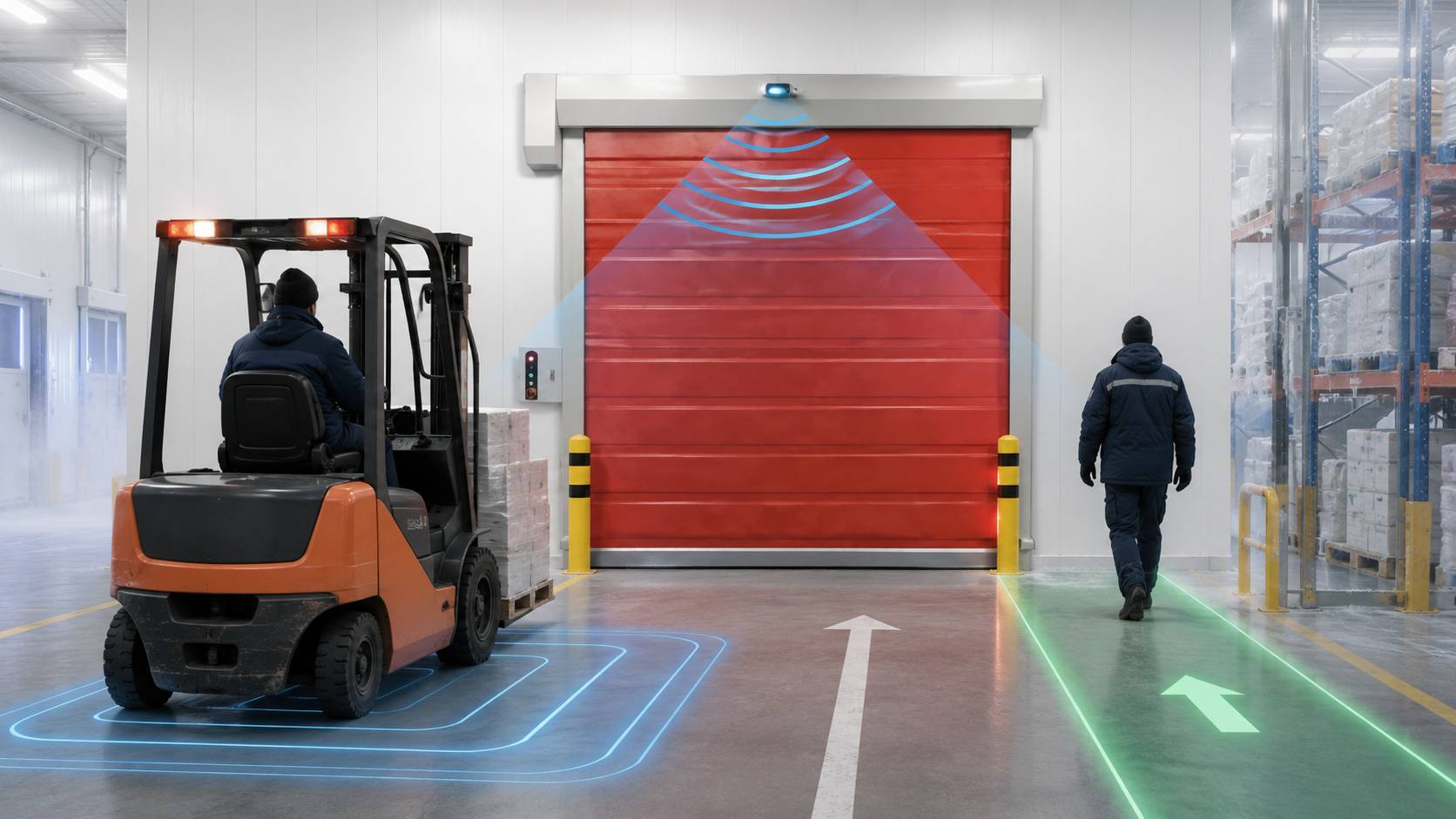
The opening command should match how users approach the entrance. Automatic activation supports continuous traffic, while deliberate controls can reduce unnecessary cycles.
Geomagnetic Induction Fits Defined Vehicle Lanes
A geomagnetic loop can suit a fixed forklift route because it responds to metal within a defined floor area. It should be positioned far enough from the doorway to allow the curtain to rise before the vehicle reaches it.
Floor construction must permit installation, and the detection zone should be tested with the expected vehicles. The smallest and largest forklifts may not produce identical detection results.
Radar and Manual Controls Serve Different Traffic Patterns
Radar supports hands-free movement where people or vehicles approach regularly. Depending on the selected radar configuration, ordinary radar may detect both traffic types, while pedestrian-vehicle separation radar can be set to respond only to vehicles or only to people. The sensing field still needs adjustment to avoid side traffic or nearby equipment.
Push buttons suit controlled personnel access. Remote controls and pull-cord switches may also be available when they are included in the selected control package. These options can provide a deliberate opening command where automatic detection is not preferred.
Access Control Fits Restricted Rooms
Swipe cards, fingerprints, or facial recognition can support authorized entry. These systems should be reviewed with the door controller before production rather than added after installation.
The project team should confirm the interface, opening hold time, and emergency procedure. Access control does not replace closing-safety protection.
Separate Opening Control From Closing Safety
The device that opens the door is not automatically the device that protects the doorway during closing. High-traffic entrances need separate obstruction detection, especially when forklifts carry loads at different heights.
Infrared Sensors Monitor the Closing Area
An infrared sensor can detect a person or object in the protected path and signal the controller to stop or reverse closing. Its position should reflect real traffic rather than a generic mounting point.
The final test should include pedestrians, loaded forklifts, and pallets extending beyond the vehicle frame. Sensor alignment should be checked again after nearby guards or equipment have been installed.
Forklift Loads Create Irregular Obstruction Heights
A driver may be clear of the opening while forks, cartons, or a pallet edge remain below the curtain. Safety testing must therefore cover the complete load profile, not only the cab position.
Stops, reversals, and slow movements near the threshold should be included. Side-column protection can reduce impact risk, but it should not block the detection field or maintenance access.
Plan for Power or Control Interruptions
The entrance plan should state what happens during a power interruption, control fault, or refrigeration emergency. Manual operation, alternative access, and emergency opening arrangements depend on the selected model and building layout.
The project team should also confirm personnel escape and emergency-access requirements under the applicable local building rules. These requirements should not be assumed from the door specification alone.
Compare the Product Specification With the Actual Entrance
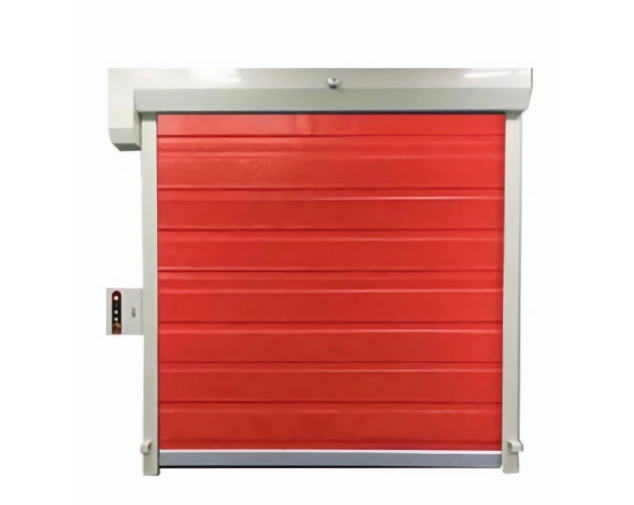
Once the technical requirements are clear, the product specification can be checked against the actual entrance rather than treated as a fixed package.
The PVC High Speed Door for Cold Storage uses a three-layer sandwich curtain. PVC Coated Polyester Fabric (Low Temperature Resistant) forms the high-density industrial outer layers, while two aluminum-film layers and thermal insulation cotton form the insulation core. Its structure also includes aluminum guide elements, polymer track components, and a POM steel zipper. For freezer-area installations, the guide track includes an antifreeze device. The listed maximum reference size is 4500 mm wide by 5000 mm high. Opening options include push button, radar induction, geomagnetic induction, swipe card, fingerprint, and facial recognition, while an infrared sensor supports obstruction protection.
The listed temperature range is about -18°C to +70°C. This is a product reference rather than a substitute for site review. A project near the size limit, exposed to severe humidity, or facing frequent frost may require further configuration checks.
Gudsen can review opening dimensions, temperature conditions, traffic duty, control preferences, and safety needs after the buyer provides drawings or clear site photographs.
Prepare a Complete Cold Room Door RFQ
A useful quotation request should describe the internal and external temperatures, opening dimensions, wall and floor condition, busiest-hour traffic, vehicle and load sizes, and whether personnel share the lane. It should also state the preferred opening method, access-control requirement, power supply, frost concern, and safety coverage.
Photos should show the opening from both sides and include nearby equipment. This gives the supplier a basis for checking the curtain, guide system, drive position, sensor layout, and installation method without relying on assumptions.
Finalize the Door Around Temperature and Traffic
A refrigerated warehouse entrance and a lower-temperature frozen-storage entrance may look similar on a drawing, yet their operating risks can differ. The correct specification follows the temperature difference, humidity, traffic pattern, sealing path, frost control, and closing safety. Selection should not rely only on curtain material or a general low-temperature product label.
For related background on leakage, frost, and entrance upgrades, review Frozen-Air Loss at Refrigerated Entrances. The final selection still needs project-specific dimensions and operating data.
When the temperature range, opening size, traffic pattern, and control requirements are ready, send the project details for a cold-room door configuration review. A complete brief makes it easier to check insulation, sealing, sensing, and installation as one coordinated system.
FAQ
Q:What is the difference between a cold storage door and a freezer door?
A:The terms can overlap, but operating conditions may differ. A chilled warehouse entrance can work above freezing, while a lower-temperature entrance usually faces a larger temperature difference and greater frost risk. The final configuration should follow the setpoint, humidity, traffic, and sealing requirement.
Q:How does the track resist freezing in freezer areas?
A:For freezer-area configurations, the guide track includes an antifreeze device designed to reduce ice buildup and maintain reliable curtain movement. Its power supply, control method, and service access should be confirmed during project planning.
Q:Which opening method is suitable for forklift traffic?
A:Geomagnetic induction can suit a defined metal-vehicle lane. Radar can support hands-free traffic, while pedestrian-vehicle separation radar can be configured for a selected traffic type. The opening method should be paired with separate closing-safety detection and tested with the actual forklift and load.