




How to Match PVC Rapid Roll Door Motor Power to Door Size
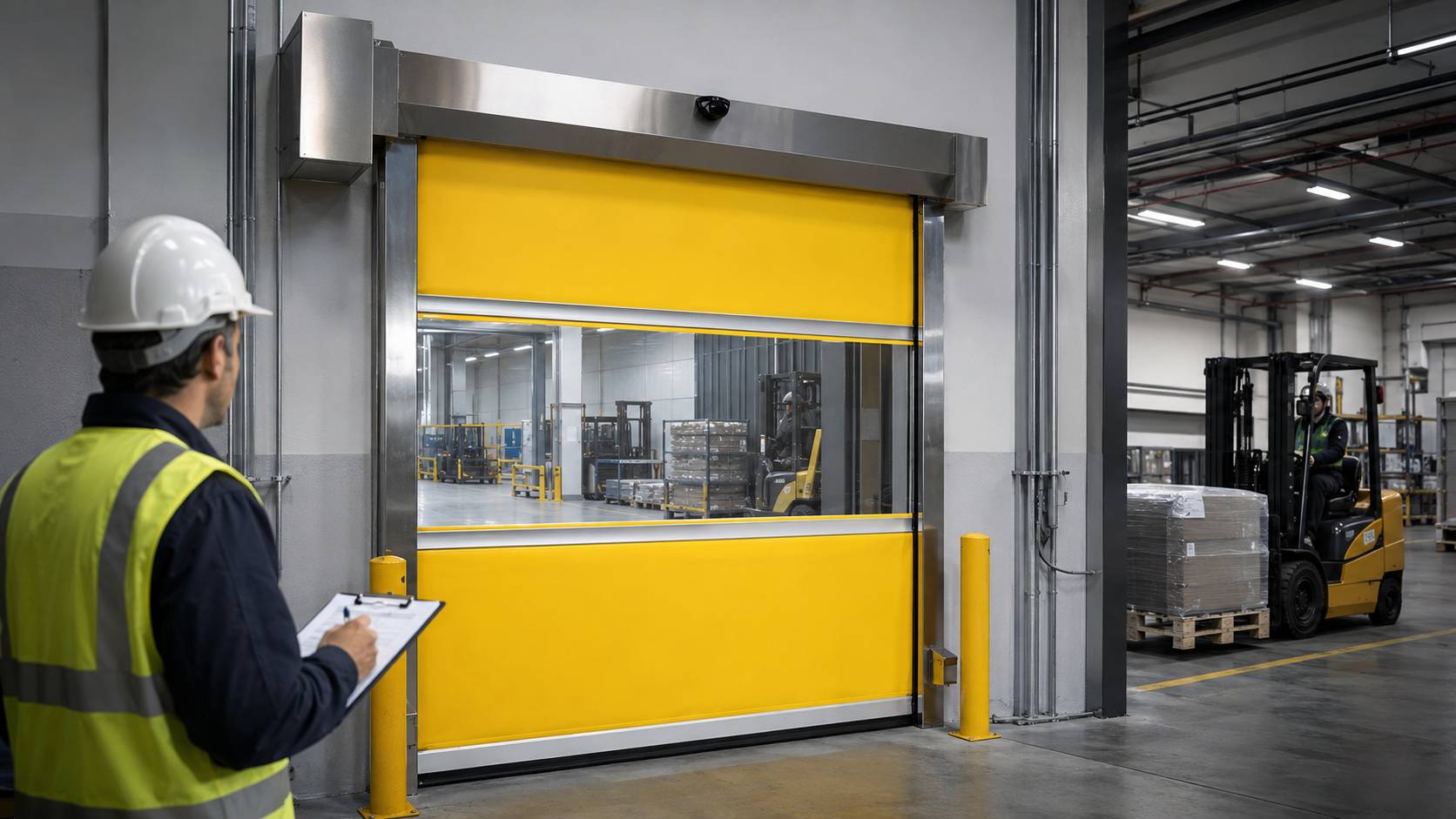
A larger industrial opening usually places more demand on the drive system, but width alone does not determine motor power. Door height changes the curtain area, while the transparent window and reinforcement add moving mass. Opening speed affects acceleration and braking. Daily traffic, wind exposure, guide design, and power supply also influence the final configuration.
A PVC rapid roll door should therefore be specified as a complete system rather than as a curtain connected to the highest available motor. A suitable rapid roll door motor must match the moving assembly, operating duty, and site conditions. The following checks help project teams prepare a reliable specification without a fixed door-size-to-power formula.
Start With the Complete Roll Door Dimensions
Motor review begins with accurate opening data.
Measure Clear Width and Height Separately
Measure clear width at the top, middle, and bottom, then check height at both sides and near the center. Differences can reveal an uneven floor, a sloped beam, or walls that are not parallel.
Width and height should remain separate in the project file. Two openings with a similar area may have different curtain geometry, shaft loading, and wind response.
Confirm the Required Travel Height
The usable travel height should reflect forklift masts, loaded pallets, conveyors, or other moving equipment. Some sites use a partial-open setting for personnel and full opening for vehicles, but the complete travel still determines the mechanical design.
Restricted headroom can also change the shaft, cover, or mounting arrangement.
Check Space Around the Opening
A roll door needs room for guides, shaft, motor, control box, safety devices, and maintenance access. Pipes, racks, cable trays, or wall guards may restrict these positions.
Concrete, steel frames, insulated panels, and existing structures do not provide the same fixing conditions. A suitable motor cannot compensate for weak supports or misaligned guides.
Calculate What the Motor Has to Move
The clear opening defines the geometry, but the drive moves the curtain, vision panel, reinforcement, bottom components, and shaft assembly.
Curtain Area Changes With Width and Height
As width and height increase, the amount of PVC fabric increases. A taller curtain also completes a longer travel path and forms a larger roll around the shaft.
This is why a rapid roll door motor cannot be selected from width alone. Two doors with the same width may need different drives when one is taller or uses a heavier curtain build.
Transparent Windows and Reinforcement Add Load
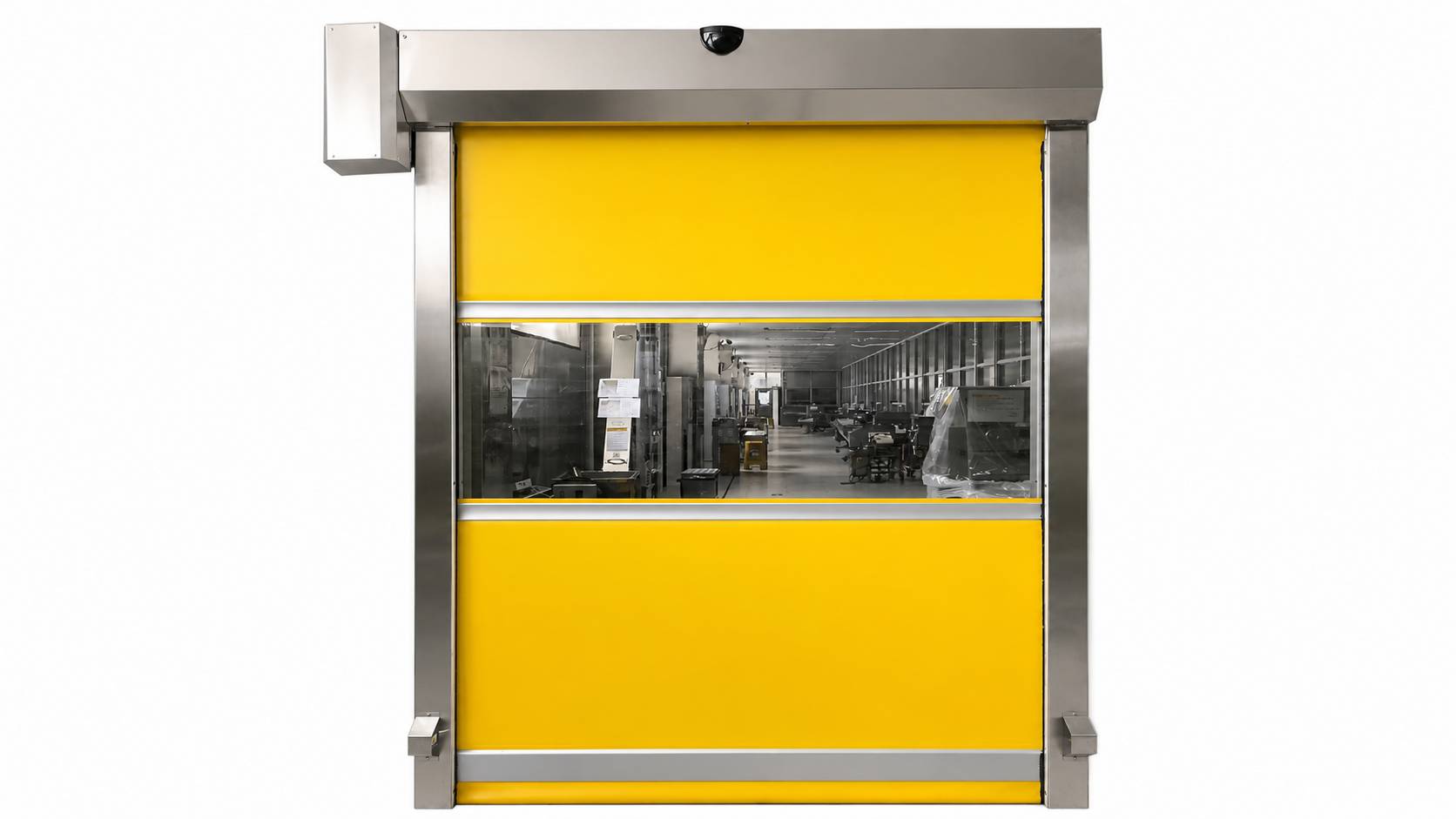
One current configuration combines 0.8 mm industrial base fabric with a 1.2 mm transparent window. The window supports visibility, but it remains part of the moving curtain.
Aluminum alloy wind-resistant strips may also be added according to size and installation conditions. More reinforcement can improve curtain stability, yet it also changes the moving assembly. The supplier should determine the number and spacing for the actual roll door.
Guide and Shaft Configuration Changes With Size
Larger openings may need wider guides, different shaft details, or stronger top support. Project examples show that guide dimensions can increase as door width grows, but they should not be treated as a universal sizing table.
Increasing motor power does not correct an undersized guide or poorly supported shaft. The drive and mechanical structure must be checked together.
Add the Operating Duty to the Motor Review
Two doors with the same dimensions may have very different workloads. A warehouse transfer point used throughout a shift places more demand on the system than an occasional maintenance entrance.
Daily Cycle Frequency Changes the Duty Requirement
The inquiry should state expected daily cycles and peak-hour activity. Average use can hide short periods of continuous movement during dispatch or shift changes.
High-frequency operation affects motor duty, heat management, braking, and service planning. The supplier needs the real operating pattern, not only a general description such as frequent use.
Opening Speed Changes Acceleration Demand
Faster movement reduces waiting time, but the drive must accelerate and stop the curtain smoothly. The referenced PVC rapid roll door operates at approximately 0.5 to 1.5 m/s, depending on the selected design and settings.
The highest speed is not automatically the best setting. A tall opening, mixed traffic, or short approach distance may need more moderate movement and carefully adjusted braking.
Stop-and-Start Conditions Affect the Drive
False radar activation, short closing delays, and frequent reversals can create more starts than the planned traffic count. Interlocked doors, conveyor signals, and access-control systems can also change the workload.
The specification should explain how the roll door is triggered, how long it stays open, and whether it may reverse during closing. This helps the supplier match the motor and controller.
Account for Conditions Beyond Door Size
Dimensions and cycle frequency are central, but the environment can add load or change the required level of protection.
Indoor and Outdoor Positions Create Different Loads
Flexible PVC doors are often used between indoor factory, warehouse, food-processing, pharmaceutical, cleanroom, cold-storage, or loading areas. When the opening faces outside conditions, wind and weather require a separate review.
The supplier still needs the installation position, building exposure, surrounding openings, and local conditions.
Wind Pressure May Require More Reinforcement
Wind can push the curtain against the guides and increase stress on the reinforcement system. After the site conditions are reviewed, a wider span may require a revised number of wind-resistant strips or a different door structure.
Additional reinforcement also affects movement. Motor, shaft, guides, and reinforcement should therefore be checked as one system.
Temperature and Contamination Affect Protection
Temperature, moisture, dust, oil, and cleaning routines influence the motor and control enclosure. The relevant range lists operating temperatures from about -30°C to +70°C and protection options such as IP54 or IP65, depending on configuration.
A dusty workshop, washdown zone, cold room, or exterior entrance may still need a different enclosure, cable, sensor, or maintenance arrangement.
Use the Motor Power Range as a Selection Boundary
A motor range narrows the options, but it should not become a fixed lookup chart.
Lower-Power Options Fit Only When the Complete Load Allows
The minimum available motor rating should be confirmed for the selected door configuration. A lower-power option may suit a smaller indoor door with moderate traffic, but width alone cannot confirm the choice.
Height, curtain build, reinforcement, target speed, cycle frequency, and voltage must also be checked.
Higher-Power Options Do Not Replace Structural Checks
Available motor configurations extend to approximately 2.2 kW. Selecting the highest figure does not solve guide, shaft, frame, or fixing problems. Excess power is not a substitute for balanced mechanical design.
Smooth acceleration, controlled stopping, correct limit positioning, and compatibility with the reducer matter as much as nominal kilowatts.
Electrical Supply Must Match the Selected Power Range
Current configurations can use 220V or 380V at 50Hz. The motor, servo controller, encoder, safety inputs, and activation devices should be confirmed as a matched package.
The inquiry should identify site voltage, frequency, and required interfaces before production.
Avoid a Fixed Door Size to Motor Power Formula
A simple table assigning one motor to one door width would hide too many variables. The same opening can use different curtain materials, window areas, reinforcement, speeds, traffic levels, and control logic.
A more reliable method starts with measured width and height, then adds curtain construction, operating duty, environment, and power supply. The manufacturer can then match the drive and mechanical structure. This prevents the roll door from being treated as a standard electrical appliance when it should be specified as project equipment.
Check Whether the Opening Still Fits a Rapid Roll Door
The referenced product can be customized up to approximately 5500 mm wide by 4500 mm high. This is an initial boundary, not an automatic recommendation for every opening inside it.
A door near the maximum size needs closer review of wind pressure, guide structure, shaft support, traffic, and installation space. Beyond the practical range, a stacking door, flexible lifting door, or another large-opening design may be more suitable. A larger motor alone does not make the same structure suitable for an oversized opening.
Apply the Method to a Current Product Specification
The PVC Rapid Roll Door combines an industrial PVC curtain, transparent viewing section, stainless-steel guides, servo drive, and several activation and safety configurations. Its reference data includes a maximum custom size of about 5500 by 4500 mm, opening speeds of roughly 0.5 to 1.5 m/s, 220V or 380V power, and motor configurations extending to approximately 2.2 kW. Available safety configurations include a light curtain, bottom-edge protection, and automatic reverse.
Gudsen can review opening dimensions, daily traffic, indoor or outdoor position, target speed, wind conditions, voltage, and control requirements before confirming the drive. The purpose is to match the complete door body and operating duty rather than simply choose the largest motor.
Prepare the Information for a Motor Review
A useful inquiry states the finished width and height, headroom, wall structure, installation position, traffic type, daily cycles, peak-hour frequency, target speed, curtain and window requirements, wind exposure, power supply, activation method, safety devices, and automation interfaces.
Site photographs should show the opening from both sides and include nearby pipes, racks, equipment, and floor conditions. This allows an industrial roll door supplier to evaluate the motor, shaft, guides, reinforcement, controller, and installation together.
For broader procurement context, Industrial High-Speed Roller Doors Buyer’s Guide explains how opening size, traffic, sealing, safety, and installation details should be written into an RFQ before quotations are compared.
Match the Complete Door System Before Ordering
Motor power is one part of the specification. The door works as a system of curtain, reinforcement, shaft, guides, motor, reducer, controller, sensors, and structural fixings.
Before the rapid roll door motor is selected, send the clear opening, operating frequency, site conditions, voltage, and control requirements for a complete roll door configuration review. A coordinated review reduces the risk of receiving a drive that fits the quotation but not the actual entrance.
FAQ
Q:Can roll door motor power be selected from door width alone?
A:No. Width is only one variable. Height, curtain construction, transparent windows, reinforcement, opening speed, cycle frequency, wind exposure, guide design, and power supply also affect the final selection.
Q:What motor power range is available for a PVC rapid roll door?
A:The referenced product offers motor configurations up to approximately 2.2 kW. The minimum available rating and final motor power depend on the complete door dimensions, structure, traffic, and installation conditions.
Q:Does a larger roll door always need the highest motor power?
A:No. A larger opening usually increases the moving load, but the final choice also depends on height, curtain weight, reinforcement, speed, duty cycle, and mechanical design. A higher-power motor cannot correct an unsuitable guide, shaft, or frame.