




What Should a High-Speed Door Maintenance Routine Actually Cover?

A high-speed door maintenance routine is often written as a cleaning list: wipe the curtain, clear the guide, listen for a new noise. That misses what actually stops a busy opening. A rapid door is an automatic machine that decides when to move, how far to move and what to do when something is in the way, and each of those decisions depends on parts that wear: the curtain and its zipper or seal, the guides, the drive and its brake, the control cabinet, and the safety devices that watch the closing cycle. The routine is worth writing when it keeps that automatic behaviour predictable, and the door’s own duty cycle, not the calendar alone, decides how often it has to happen.
The Door’s Duty Cycle Is the Real Maintenance Clock
What “High Frequency” Means in Practice
Cycle counts are the clock a high-speed door actually runs on. A simple hard fast door is built for high-frequency opening – 600 to 1500 cycles a day – and the quick-door ranges carry daily cycle ratings above 1000. Those numbers describe how often the same guides, curtain and drive elements are engaged, and they explain why a rapid door can need attention while a conventional shutter beside it is still working uneventfully. Speeds sit in the same band: the PVC high speed door opens at 0.5 to 1.5 m per second and closes at 0.6 to 1.6 m per second, while the zippered quick door runs at 0.6 to 2.0 m per second with wind resistance levels of 3 to 6. Faster travel means more energy to absorb at the end of each cycle, felt first at the curtain, the bottom edge and the point where the door stops.
What the Door Is Doing to Itself on Every Cycle
Read the door as a sequence: detection, release of the brake, travel, deceleration, seating against the floor or seal, and the safety layer watching the closing movement. Wear follows that sequence. Frequent cycles work the brake, the drive and the encoder; seating works the bottom edge and the seal; anything obstructing the path works the curtain and the guides. Maintenance asks which step has started to change, because that is where the evidence appears first: a slower stop, a longer pause before movement, a door that needs a second attempt to close.
The Checks That Belong on the Routine
Curtain, Zipper and the Anti-Collision Reset
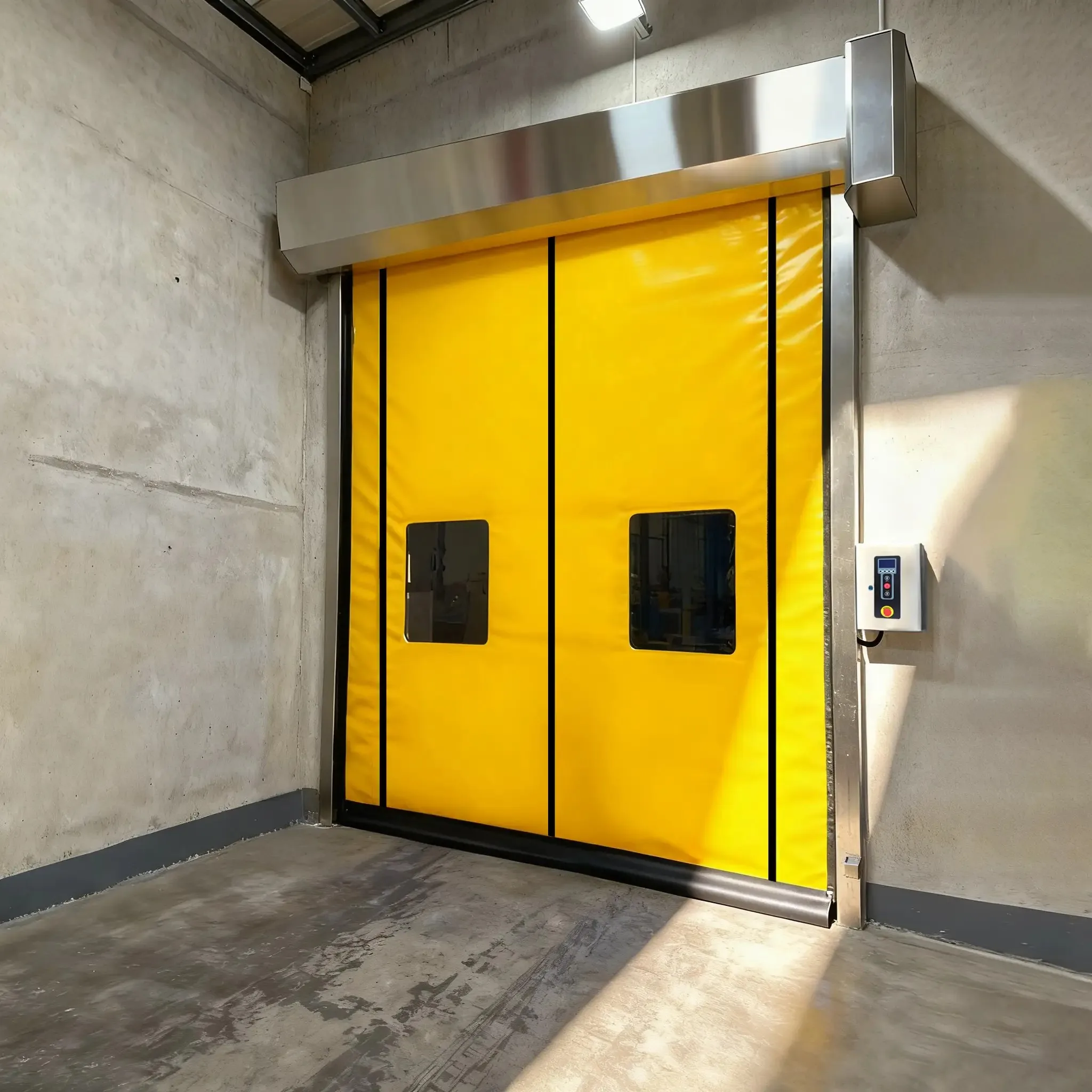
The curtain is the most visible part and the one that reveals impacts. Look for deformation along the leading edge, scuffs concentrated at one height, and a curtain that no longer hangs evenly. On a zippered door the closing relationship is carried by the zipper: a zipper-type bite structure with POM wear-resistant zippers re-seats the curtain itself after it is knocked out of the track. The maintenance question is whether that behaviour still works, so the visit should check the reset deliberately rather than assume it. On the cold-store rapid door, anti-collision reset is automatic during ascent after an impact and supports 150,000 or more trouble-free cycles a year; other models can need manual repair and a control-unit setting after the same event, which the operator is better off knowing before it happens.
Guides, Seals and the Cold-Room Heating Device
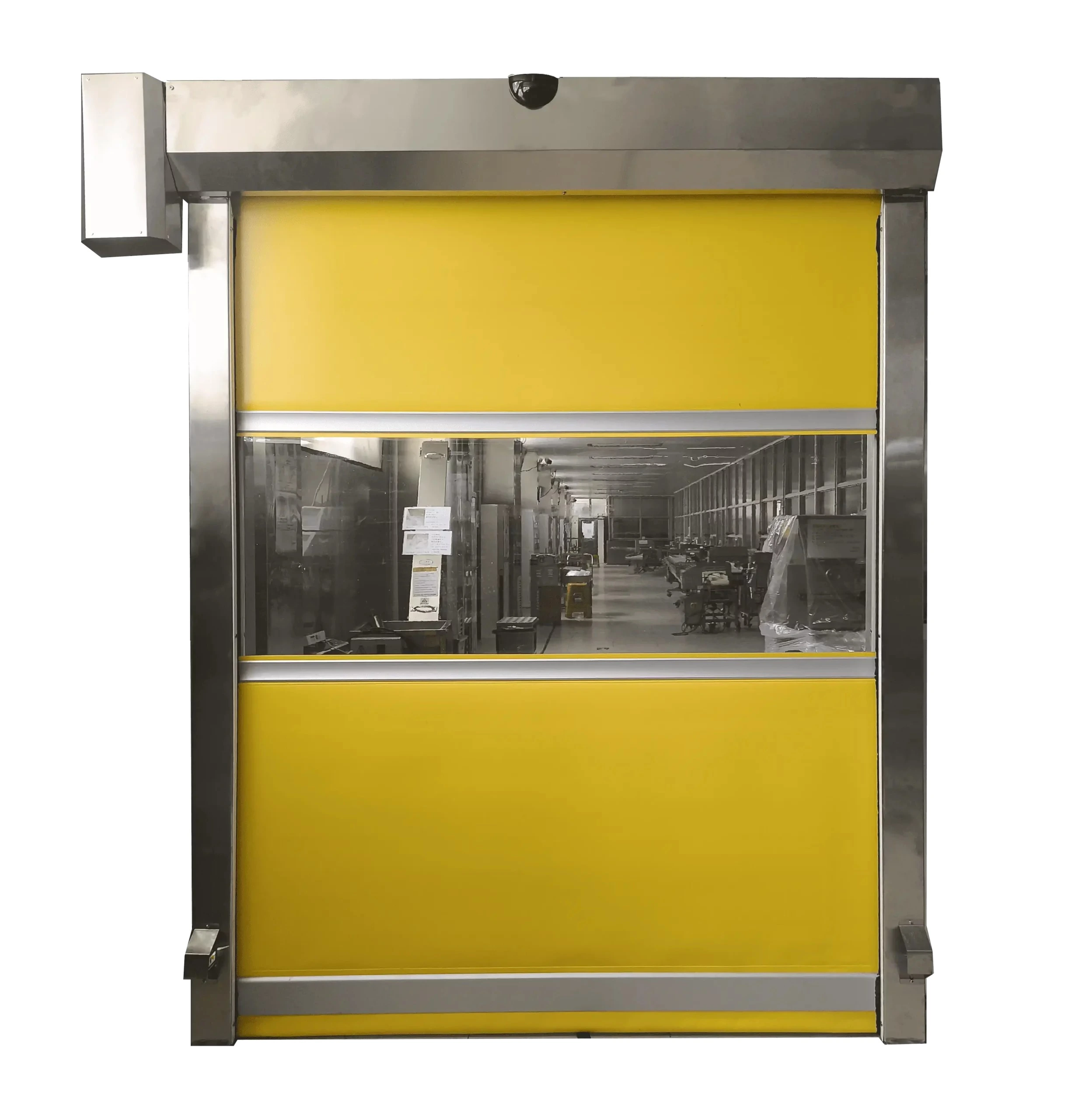
Guides keep the curtain in its plane and take the sideways load of every cycle. Check both uprights for impact damage, loose fixings, debris and coating loss, and confirm that the curtain runs without rubbing. Then look at the seals, because they are what the door is bought for: on a cold storage rapid door the guide rails are double-sealed and the top and bottom of the door body are sealed as well, which is what maintains airtightness and isolation. Other door types use fewer seals, so check whichever strips are actually fitted. A seal that has hardened or torn does not just leak air; it also changes how the door seats, which the drive then compensates for.
Cold-store openings add one item that other doors do not have. A cold storage rapid door built for sub-zero duty carries a heating device in the guide rail, sized to stop the rail freezing from the heat exchange that frequent operation creates; where the door is specified that way, the heating circuit and the protection rating are part of the routine rather than an afterthought. Control boxes and components on this range are built to IP54 or above so they stay dustproof and waterproof in harsh environments, and a fog-resistant photoelectric sensor suits cold-storage rooms, where condensation would otherwise confuse the optics.
Drive, Control Cabinet and the Manual Release
The drive group is where a high-speed door differs most from a conventional shutter. GUDESEN’s PVC high speed door uses an integrated high-frequency motor and reducer with a 220 V or 380 V supply at 50 Hz, protection level IP55 and a power range of 0.55 to 6.5 kW, with a power-off brake and a manual brake release, controlled by PLC and inverter. That explains what to check: the brake, which holds the door between cycles; the release, the only way to move the door when power or drive fails; the panel and its protection rating, because dust and water reach the cabinet before the motor; and the encoder on hard doors, because a door stopping in the wrong place usually reports a positioning problem rather than a curtain problem.
One of those checks matters more for safety than for production. When power fails, the electronic control system releases the motor brake so the door can be opened by hand, which is the difference between an opening that still works and one that blocks the route until a technician arrives. Verifying that release, and that staff know where it is, belongs in the same visit.
Why the Safety Devices Need Their Own Test
Photoelectric, Airbag and Light Curtain Are Different Layers
A high-speed door usually carries more than one safety device, and they are not interchangeable. On the quick-door series, safety photoelectric protection is standard equipment; a safety airbag and a safety light curtain are options. The photoelectric device is an infrared through-beam pair installed at the lower part of the frame: if a person or object remains under the door, the door does not fall. A light curtain is a broader layer – a 1.8 m array of infrared transmitting and receiving switches with a point every 10 cm – so a person or vehicle is detected even if only one point of the array is blocked. On the cold-store rapid door the combination is an infrared anti-collision sensor with a safety airbag, and the door reverses when it meets an obstruction.
Because the layers do different jobs, testing one does not verify another. A closing cycle that stops for a beam does not prove that the light curtain responds, and an airbag that reverses the door does not prove that the beam is aligned. The visit should test each fitted device against what it is supposed to detect.
What a Safety Test Has to Prove
A safety device that no longer reacts is worse than a door that never had one, because the site behaves as though the protection is still there. Testing should reproduce the real case: an object left in the opening, a person walking through a closing cycle, a pallet truck stopped inside the doorway. Detection settings that are too generous create their own failure: radar activation set too close leaves the door cycling up and down repeatedly, while misaligned or blocked photoelectric points hold a door open when it should close. The high speed door sensor comparison for forklifts and pedestrians explains how activation devices and protective devices differ, which is the distinction a test plan has to hold on to. The right protectors are chosen when the door is specified, so the routine’s job is to prove the fitted devices still do what they were chosen for.
Matching the Routine to the Door Type and Environment
PVC Curtains, Hard Doors and Cold-Store Doors
The door’s construction decides which checks carry the most weight. A soft PVC curtain, as on GUDESEN’s PVC high speed door with its 1.5 mm PVC viewing window and galvanised guide box, tolerates impact by flexing, so the routine concentrates on the curtain, the seals and the reset behaviour. A hard fast door built from aluminium profiles and metal panels, with an absolute encoder for positioning, damages differently: deformation, panel alignment and the positioning device matter more than curtain flexibility. Zippered and insulated cold-store doors sit between the two, because the zipper or brush seal is both a performance part and a wear part. The high speed door range shows where those constructions sit, and the PVC high speed door sets out the specification behind those checks.
Environment: Cold, Washdown, Dust and Outdoor Openings
Environment changes the interval more than most facilities expect. A cold-store door faces frost in the guides and condensation on the optics; a washdown area brings humidity and cleaning chemistry; a dusty process area fills guides and seals; an exposed opening adds wind, which is why wind resistance is specified per door type: up to 1176 Pa on the PVC high speed door, and levels 3 to 6 on the zippered quick door. Two identical doors in one building can need different intervals, so start from the duty and environment each opening has, then let each visit confirm or shorten the schedule.
From Maintenance to Repair: Reading the Pattern
Symptoms That Point to a Component
Maintenance keeps a working door predictable; repair starts when the door stops behaving as designed. A curtain that resets after an impact keeps working, while a curtain that needs the control unit reset every time points to the guide or the zipper rather than to the operator. A door that closes on the second attempt, stops short, or drifts past its seated position points to the encoder, the stopping settings or the brake. Repeated activation with nothing in the opening points to detection adjustment. A seal that no longer seats is a wear item that turns into a drive complaint if it is left alone, because the door is asked to hold against a gap that was not there when it was installed.
What to Send Before the Visit
Repair visits become short when the door is described rather than guessed: door type, drive and control system, fitted safety devices, daily cycle count, environment, and the symptom with when and where it appears. GUDESEN supplies installation files or videos and supports installation remotely through its own personnel, so the installation file or video can be checked when a configuration has to be confirmed, and its products carry a one-year free warranty with lifetime maintenance. A spare-parts plan shortens the stop as well, because the parts that hold up a shift are usually small: seals, sensors, the bottom edge, guide components and switch devices. The spare parts checklist for warehouse maintenance teams sets out how that list is organised around the door rather than the shelf.
Conclusion
A high-speed door maintenance routine follows the door’s duty cycle and its own construction, not a generic cleaning list. Count the cycles, then check the sequence the door performs: the curtain and its reset behaviour, the guides and seals, the drive, brake and manual release, and each safety device against the threat it was fitted to stop. Match the interval to the door type and the environment at that opening, and treat anything returning after it was corrected as a component problem rather than a routine one. Sending the door type, drive, fitted safety devices, cycle count and symptom history to GUDESEN lets the visit, and the parts it needs, be prepared before the opening leaves service.
FAQs
Q1: How often should a high-speed door be serviced?
A1: The interval follows the cycles the door completes and the environment it works in, not a universal number of months. A simple hard fast door is built for 600 to 1500 openings a day and quick-door ranges are rated above 1000, so two doors in the same building can need very different schedules. Start from the cycle count and conditions at that opening, then shorten the interval when a visit keeps finding the same wear or seal damage.
Q2: Can the facility’s own team carry out the checks?
A2: The visible, low-risk part is realistic for a trained in-house team: how the curtain hangs and resets, keeping the guides clear, confirming the bottom edge and seals are intact, and reporting changes in noise or stopping position. Adjusting the drive, stopping settings, brake release or safety devices belongs with the supplier or a qualified technician, because those settings decide how the door behaves when someone is in the opening. A written record of what was seen keeps that division useful.
Q3: When does a high-speed door problem become a repair rather than maintenance?
A3: When the door stops behaving as designed and stays that way. A curtain that needs the control unit reset after every impact, a door that closes only on the second attempt, a drifting stopping position, repeated activation with nothing in the opening, or a seal that no longer seats all point to a component or a setting rather than wear. On cold-store doors that includes the guide-rail heating circuit and the optics condensation can confuse.