




How to Use a Dock Leveler: Sequence, Checks and Bay Routine
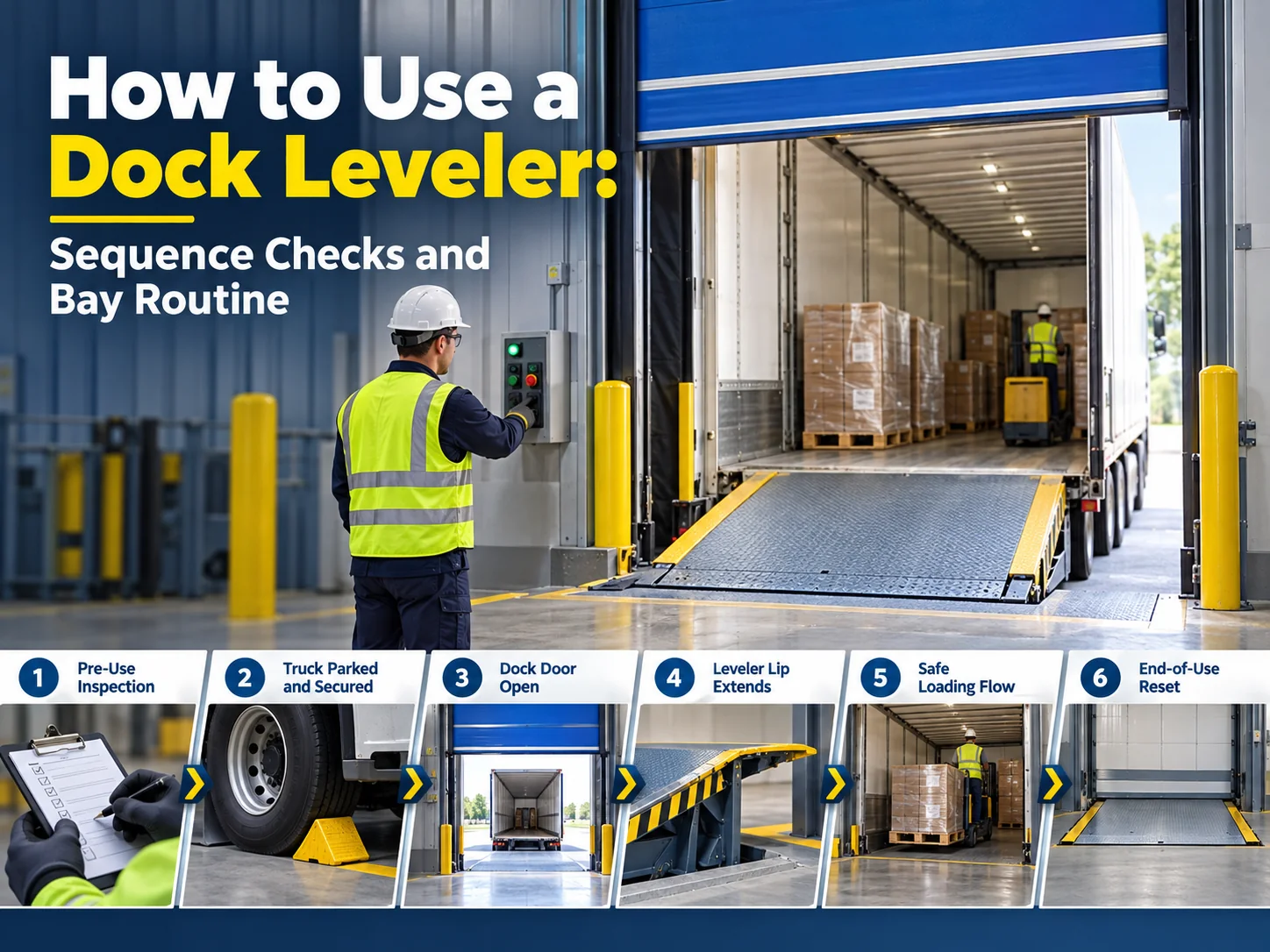
Knowing how to use a dock leveler is really knowing one order: the trailer cannot move, the lip is properly seated on the trailer bed, and nobody starts loading before both of those are confirmed. Operators who know the buttons but not that order are the reason bays have near misses that nobody can trace to a single step.
Anyone learning how to use a dock leveler should learn the order first and the controls second. The sequence below is written to be used, not just read: it covers what the equipment actually does, what to check before anything moves, the order of operation, how the steps differ between the platform types a warehouse usually has, what must never happen while a load is on the lip, and how to write the routine down so it stops depending on memory.
What a Dock Leveler Does in the Loading Sequence
What is a dock leveler, in practice? It is the piece of equipment that solves one problem: a trailer bed rarely sits at the same height as the warehouse floor. The dock door opening stays fixed, the trailer arrives at whatever height its suspension and load have produced, and a forklift cannot climb a step. A loading dock leveler is the moving bridge that closes that gap for the duration of the load, and it is the only part of the bay that changes height while the trailer is standing there.
The Bridge Between the Dock and the Trailer Bed
That bridge has to reach the trailer, not merely rise. A platform that lifts to the height of the dock edge but does not overlap the trailer bed leaves a lip of air that a wheel will find. Every operating routine therefore begins with the trailer: restraint first, then the bridge, then the load.
Lifting the Platform and Seating the Lip
How does a dock leveler work in practice? Two motions make a usable bridge: the platform rises, and an extension – the lip or tongue plate – reaches over the trailer bed so the platform and the trailer overlap. Only after that overlap exists does lowering the platform transfer the load onto the trailer, which is why the contact check matters more than the height itself.
Checking the Trailer and the Bay Before You Operate
Most of the risk in dock work is decided before the platform moves. Walk to the bay and confirm two groups of conditions – the trailer side and the bay side – rather than starting from the control panel.
Trailer Restraint and Wheel Chocks
The trailer must be unable to move away from the dock. Use the bay’s restraint device as designed, and where the site requires chocks or a trailer brake check, confirm them before the platform is raised. The driver should know the trailer is being worked on and should not pull away until the bay signals that loading has finished.
Restraint is not a formality. A trailer that rolls forward while a forklift is on the lip can drop both the truck and the operator, and it happens with suspended air-ride trailers as readily as with steel springs.
Dock Area, Lighting and People
Then look at the bay itself. The approach and the trailer floor should be clear of loose material, the dock lights and trailer lights should be working well enough to see the load edge, and anyone not involved in the operation should be out of the bay and off the ramp. Everything about how does a dock leveler work assumes this area is clear before the platform moves, because the equipment cannot see what is behind the forklift.
The Operating Sequence, Step by Step
With the checks complete, the sequence is the same shape at most bays:
-
Step 1: Confirm the trailer is restrained and the bay is clear.
-
Step 2: Open the dock door and confirm the trailer bed, not only the trailer position.
-
Step 3: Raise the platform and extend the lip or flip the tongue so it clears the trailer bed.
-
Step 4: Lower the platform until the lip rests fully on the trailer bed along its width.
-
Step 5: Confirm the lip overlap before any wheel crosses it.
-
Step 6: Load or unload with the load staying inside the platform and trailer limits.
-
Step 7: When the work is finished, bring the forklift clear, return the platform to its stored position, then release the restraint.
-
Step 8: Report any damage, unusual noise or movement before the next trailer is worked.
Step 4 is where most of the practical difficulty sits. If the trailer bed is higher than the dock, the platform finishes at an upward angle; if it is lower, the platform finishes downward. Both are normal, but in both cases the lip has to sit flat on the trailer bed rather than on the trailer’s edge or on a damaged section of the bed.
Types of Dock Leveler and How the Sequence Differs
The sequence above describes what the operator has to achieve. How the equipment achieves it depends on the platform family installed at the bay, which is why one bay’s routine is not automatically correct at the next door – and why the loading dock leveler at each door should be identified before an operator is assigned to it. What is a dock leveler at one door is not quite what it is at the next: the family, the lip mechanism and the pit all change, even when the bay looks the same from the yard.
Telescopic Platforms: The Lip Is Pushed Out
On a telescopic unloading platform, GUDESEN documents a hydraulic sequence in which the main-board cylinder lifts the platform, a smaller cylinder pushes the lip plate out, and lowering the platform then places that lip on the rear of the truck. The practical consequence for the operator is that the extend step happens while the platform is raised, and the lip must be fully out before the platform is lowered.
Flap Platforms: The Lip Is Flipped
The flap platform achieves the same overlap differently: the main-board cylinder lifts the table panel, and a small oil cylinder flips the lip plate, which is then placed on the rear of the truck as the platform lowers. Because the lip rotates rather than extends, an obstruction under the lip or a partially flipped plate is easy to miss – so the pre-load check is on the plate’s resting position, not on its travel. The instructions for how to use a mechanical dock leveler follow the same branch of this logic: the checks stay identical, and only the lift and the lip movement are produced differently.
Hydraulic and Mechanical Tilt Platforms
The inclined loading and unloading platform achieves the connection between the warehouse and the truck with a steel tongue plate that overlaps the platform with the truck, and it is produced in hydraulic and mechanical versions. The semi-fixed structural design supports loading and unloading requirements of different specifications, with a maximum tilt of -300 to 450 mm. Because the overlap is produced by inclination rather than by an extending lip, the operator’s check is whether the tongue is seated on a straight section of the trailer bed and whether the tilt stays inside that working range.
Platform selection is not the same task as operation: dock leveler selection between flip plate and telescoping lip designs belongs to the buying decision, and the load capacity question belongs to specification. Whichever type is installed, the platform’s size, pit dimensions and lip-plate thickness are what the routine should name when a trailer does not fit the pattern.
Those figures are not interchangeable between families. The telescopic platform is produced with telescopic lengths of 650 mm and 980 mm and lip plates from 12 x 400 up to 16 x 400 depending on the load case, while the flap platform uses its own standard size and pit table with 12 x 400, 14 x 400 and 16 x 400 lip plates. When a bay’s routine says “extend the lip”, the number behind that instruction belongs to the platform at that door, and an operator moving to a bay with a different platform family is working to a different set of limits.
What Never to Do While Loading
Some actions have no safe version, and they belong in the routine as prohibitions rather than warnings:
-
never operate the platform with a forklift or a person on the lip;
-
never pull away, drop a trailer’s suspension or release a restraint while the load is on the platform;
-
never load a trailer whose bed is above or below the platform’s designed working range;
-
never operate a platform with a damaged lip, bent tongue, missing guide or visible hydraulic leak;
-
never send a wheel over a lip that has not been checked for full contact;
-
never leave the platform stored in the raised position when the bay is closed.
Writing the Routine Into the Shift and Maintenance Plan
Only a written routine prevents incidents reliably. Write one page, keep it at the bay, and name the platform type installed there: the extend or flip step, the seating check, the restraint release point and the parking position all differ by type, and an operator moving between doors needs to see the difference rather than infer it. A second page for how to use a mechanical dock leveler is not needed if the routine says plainly which bay uses a spring-assisted lift instead of a powered one.
Add the checks that belong to a schedule rather than to a trailer: a daily look at the lip, guides and platform surface; a scheduled inspection of the hydraulic system, cylinders and seals where the bay has them; a check of restraint devices and dock lights; and a clear rule for reporting damage before the next trailer. A shift routine that records what was checked, by whom, and what was found turns an operating instruction into something that can actually be audited.
The equipment list tells the routine what to look at. The mobile loading and unloading platform is designed with a high-strength steel frame for a longer lifespan and reliable operation, and its dedicated solid tires carry a greater load without needing maintenance.
Power equipment deserves its own line in the check. The high-performance motor has a protection level of IP55 or above, the high-precision oil cylinder and imported sealing ring are chosen for stable performance and a longer service life, and an anti-cracking valve on the oil pipe ensures that the lifting platform will not suddenly drop its load if the pipe ruptures. Optional safety bumpers at the entry and exit prevent foot injury during operation.
A visible hydraulic fault therefore belongs out of service before the next trailer rather than at the end of the shift.
Exposure matters too. The lifting platform boards are produced to resist harsh external environments such as high temperature, cold, and wind and rain, which is why an open yard bay needs a different inspection rhythm from a bay that sits inside a sealed dock hall.
Conclusion
Using a dock leveler correctly is a sequence, not a skill: restraint first, lip properly seated second, load on the lip third, and nothing on the platform while it moves. The steps after that depend on the platform installed at the bay – a telescopic platform pushes its lip out, a flap platform flips it, and a tilt platform produces the overlap through inclination – so the written routine should name the type rather than describe a generic leveler. Keep the page at the bay, record the scheduled checks, and report damage before the next trailer arrives. If the bay’s platform predates the current fleet, confirm the type, lip plate and pit dimensions with GUDESEN against the loading platform range before writing the procedure into the site manual.
FAQs
Q1: What is the correct order for using a dock leveler?
A1: Restrain the trailer and clear the bay, raise the platform and extend or flip the lip, lower the platform until the lip rests fully on the trailer bed, confirm that contact, then load. Finish by bringing the forklift clear, storing the platform and only then releasing the restraint.
Q2: How do you use a mechanical dock leveler differently?
A2: A mechanical platform uses the operator’s own effort or a spring-assisted mechanism instead of a powered cylinder, so the lift and the lip movement are felt rather than held. The checks do not change: restraint, full lip contact and clear bay decide whether the load can move.
Q3: What should be checked before a forklift enters the trailer?
A3: The trailer restraint, the lip’s full contact along the trailer bed, the trailer bed condition, the wheel path and the bay lighting. The load then has to stay within the capacity and working range the platform was supplied for.