




Can Your Automatic Sliding Door Operator Handle Heavy Glass?
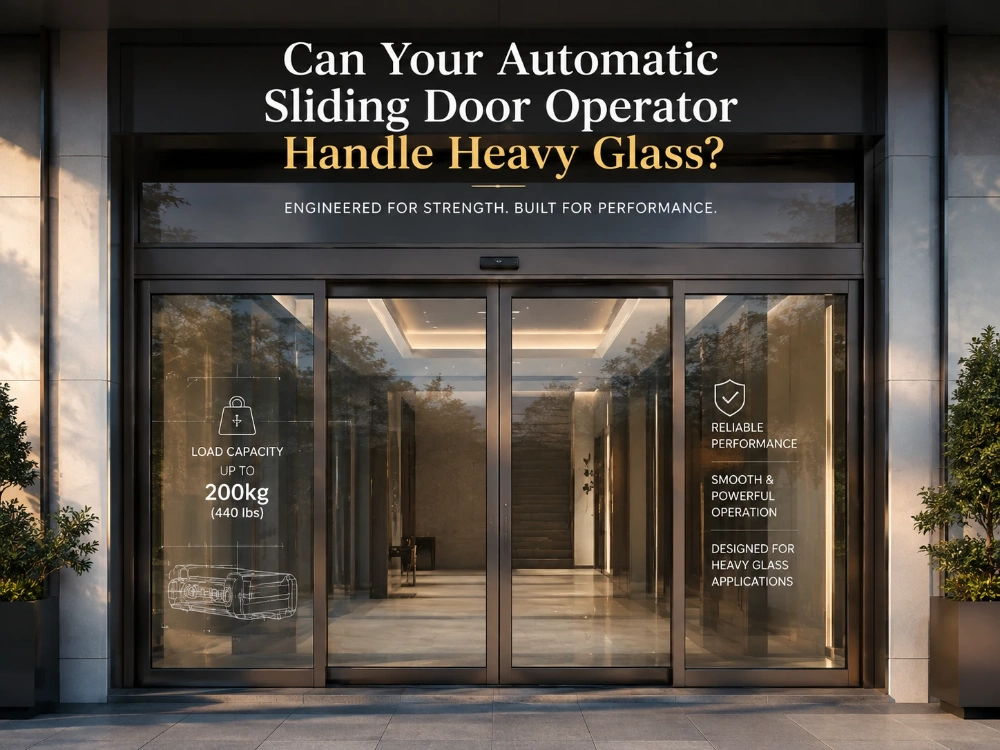
A glass entrance can look light and simple while placing a surprisingly heavy load on the drive system above it. That becomes important when a larger storefront uses tall tempered-glass leaves, wider moving panels, or a bi-parting layout.
An automatic sliding door operator should therefore be selected from the actual moving load, not from doorway width alone. The same applies when buyers search for an automatic sliding door opener, automatic door operator, or sliding door operator. Different product names often lead back to the same practical question: can the drive move the finished door smoothly every day without being poorly matched to the leaf weight?
The answer starts with the glass.
How Heavy Is the Glass Your Operator Actually Has to Move?
A useful operator calculation begins with each movable leaf. The total architectural opening is not enough.
GUDESEN commonly uses 12 mm tempered glass for automatic glass doors, while some projects may require 15 mm glass. For preliminary calculation, 12 mm tempered glass can be estimated at approximately 30 kg per square meter.
How do you calculate one moving glass leaf?
Take a moving panel that measures:
1.0 m wide × 2.4 m high
The glass area is:
1.0 × 2.4 = 2.4 m²
Using approximately 30 kg/m² for 12 mm tempered glass:
2.4 × 30 = approximately 72 kg
That 72 kg is only the glass.
The completed moving assembly also includes the fittings that move with the leaf. This is why specifying an automatic sliding door operator from glass dimensions is safer than simply telling a supplier that the doorway is “about three meters wide.”
Buyers considering a complete entrance can compare the automatic sliding glass door range while checking how many fixed and moving panels their project needs.
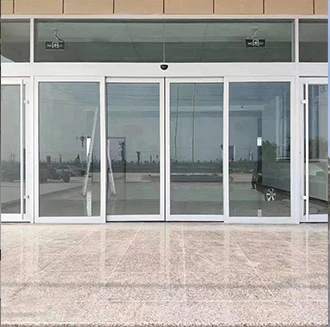
Why does single-leaf versus bi-parting matter?
A single sliding door and a bi-parting door may occupy the same overall opening, yet the operator selection is not necessarily the same.
With a bi-parting system, each moving leaf has its own dimensions and weight. If two movable glass leaves are used, the load calculation must reflect both leaves and the operator configuration designed to move them.
This is also why an automatic sliding door opener and closer cannot be selected only from one total “door weight” figure without knowing the door arrangement.
The useful RFQ data is:
-
Width and height of each movable leaf
-
Glass thickness
-
Number of movable leaves
-
Number of fixed panels
-
Single-opening or bi-parting configuration
-
Expected operating frequency
-
Existing header or wall condition
That information gives the supplier something that can actually be engineered.
Can the Operator Rating Match the Real Door Configuration?
GUDESEN has different automatic-door operator options for different moving loads.
The GMA-90 configuration supports a 90 kg single leaf or 90 kg × 2 for a double-opening arrangement. Its stated leaf-width ranges are 700–1300 mm for a single door and 700–1100 mm for a double door.
The GMA-150 configuration supports 150 kg × 1 or 150 kg × 2. Its stated leaf-width ranges are 700–1500 mm for a single door and 700–1300 mm for double opening.
Both use a DC36V brushless DC servo motor configuration and support single or double sliding arrangements.
What do the other operator capacities mean in practice?
GUDESEN also works with domestic and imported automatic-door machines.
Examples in the available operator range include:
-
Panasonic H3: 90 kg per leaf
-
GUDESEN 120 type: 70 kg per leaf
-
GUDESEN 125 type: 80 kg per leaf
-
GUDESEN 150 type: 140 kg per leaf
-
GUDESEN 200 type: 180 kg per leaf
-
GUDESEN 500 type: 250 kg per leaf
That range matters because “automatic sliding door opener” is too broad a description for serious project selection. A light office entrance and a tall heavy-glass entrance should not automatically receive the same drive configuration.
The aluminum glass door configuration gives buyers a practical reference for a glass-and-aluminum entrance using an automatic drive system.
Should the operator be selected exactly at the calculated glass weight?
It is better to avoid treating the calculated glass weight as the only number that matters.
The operator also works together with the hanger, belt, pulley, guide rail, controller, anti-sway device, and other moving or load-carrying components. Installation quality and track condition affect how smoothly that load is moved.
If the glass calculation is already very close to the available per-leaf capacity, that should trigger a closer technical review rather than an automatic model selection.
A properly specified automatic door operator should match the completed system, not just the bare glass.
Why Can a Correctly Sized Sliding Door Operator Still Perform Poorly?
A motor with enough nominal capacity can still perform badly if the rest of the installation is wrong.
The automatic door machine is a system. It includes the motor, controller, guide rail, radar, hanger, belt, pulley, and anti-sway device. A sliding door operator depends on all of these parts working together.
Is the header strong enough to carry the system?
The operator is installed above the moving leaves. If the existing wall cannot provide a secure fixing point, GUDESEN can use a steel beam to connect the motor assembly to the wall and reinforce the installation.
This should be confirmed before manufacturing.
A common project mistake is to calculate door width and motor capacity carefully but leave the header condition vague until installation. That can lead to site modifications, delays, or a mounting arrangement that differs from the original plan.
Photos of the opening, dimensions above the doorway, wall material, and any existing beam are useful before the final drawing is confirmed.
Are the door machine and moving hardware being treated as one system?
The door clamp used on movable glass is generally 1 meter long. The complete automatic glass-door arrangement can include tempered glass, steel beam, automatic door machine, door clamp, and stainless steel cover.
The stainless steel cover is not simply decorative. It encloses the motor and electrical assembly above the entrance, and GUDESEN can provide 201 or 304 stainless steel for this component.
This is one reason an automatic sliding door opener and closer should not be purchased as an isolated motor without checking how it connects to the rest of the entrance.
What Else Should Be Checked Before Ordering an Automatic Sliding Door Opener?
Weight is the starting point, but it is not the whole specification.
A buyer should also consider door travel, traffic pattern, opening method, available power, access control, and the building structure.
GMA-90 and GMA-150 systems can support optional access-control functions such as card readers, proximity-card systems, remote motor locks, and access-control network hosts. Safety-light and remote hand-pressure switch options can also be considered depending on the project.
An automatic sliding door opener used at a quiet internal office doorway does not face the same working pattern as one installed at a hotel lobby or busy commercial entrance.
Does operating frequency change the purchasing decision?
Yes, because operator selection should reflect how the entrance will actually be used.
A door may move smoothly during a short factory test and still be poorly suited to its final traffic pattern if the project information did not include expected use.
For high-traffic entrances, send the expected pedestrian flow and operating pattern with the RFQ. This helps the supplier evaluate the automatic sliding door operator as part of the complete application rather than from one static weight figure.
What should be confirmed in the final quotation?
Before approving an automatic door operator, the quotation should make clear:
-
Door opening width and height
-
Moving-leaf dimensions
-
Glass thickness
-
Estimated glass weight
-
Number of moving leaves
-
Operator model and per-leaf load
-
Opening configuration
-
Control method
-
Access-control requirements
-
Safety options
-
Header reinforcement requirement
-
Stainless steel cover requirement
-
Power conditions
-
Installation-support requirements
When buyers need help matching these details, GUDESEN technical support can work around the actual doorway and required configuration rather than treating every entrance as a standard package.
For projects where the door weight is still uncertain, it is more useful to send the glass dimensions and layout than to guess the motor model. Buyers can request an operator recommendation after the door dimensions and expected use have been defined.
Conclusion: Can Your Automatic Sliding Door Operator Handle Heavy Glass?
A heavy glass entrance does not need an oversized operator by default. It needs a correctly matched one.
Start with the dimensions of every movable glass leaf. Calculate the approximate glass weight, identify the number of moving panels, then compare that load with the operator’s per-leaf capacity. After that, check the hanger system, guide rail, mounting structure, control requirements, and traffic pattern.
That process turns automatic sliding door operator selection into an engineering decision rather than a guess.
Whether the project is described as an automatic sliding door opener, automatic sliding door opener and closer, automatic door operator, or sliding door operator, the same rule applies: size the complete moving system before choosing the drive.
FAQs
Q1: How can the weight of a 12 mm tempered glass sliding door be estimated?
A1: GUDESEN uses approximately 30 kg/m² as a calculation reference for 12 mm tempered glass. Multiply the width by the height of each moving leaf to get its area, then multiply the area by approximately 30 kg/m². Moving fittings should also be considered before the operator is finalized.
Q2: Is a larger automatic sliding door operator always better?
A2: No. The operator should match the actual leaf weight, door configuration, traffic pattern, and installation structure. An unnecessarily large unit is not a substitute for correct sizing, while an undersized unit may be poorly matched to a heavy moving leaf.
Q3: What information should be sent before selecting a sliding door operator?
A3: Send the opening width and height, number of movable leaves, dimensions of each moving leaf, glass thickness, opening layout, expected traffic frequency, wall or header condition, control method, access-control requirements, and power information.