




PVC Strip Curtains vs High-Speed Doors: Which Is Better for Busy Warehouse Openings?
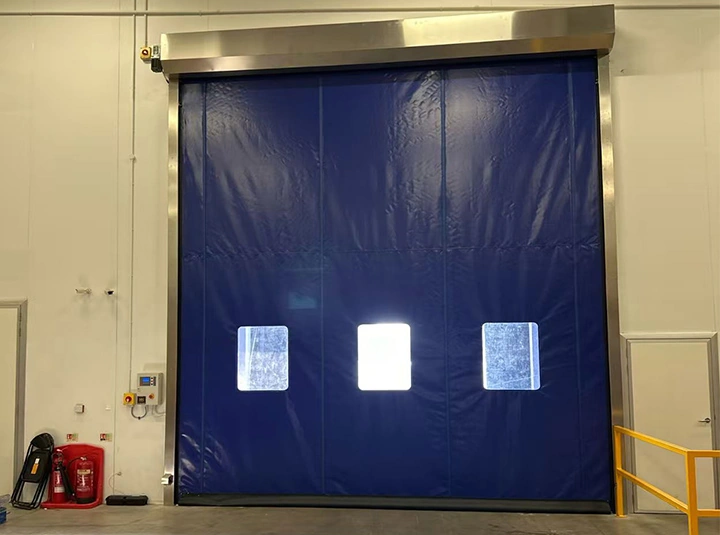
PVC strip curtains are usually enough for a lightly used internal opening, while high speed doors make more sense when traffic, environmental separation, and automatic control become part of the daily workflow. The point isn’t to replace every simple barrier with a powered door. It is to recognize when an opening has become too important to be managed as a passive partition.
A warehouse entrance can change quickly. A secondary passage starts carrying forklifts, or a packing area becomes temperature controlled. What once worked as a simple curtain begins to affect traffic flow and air exchange. That is where the choice between pvc strip curtains and high speed doors becomes an operating decision.
Key Takeaways
-
PVC strip curtains remain practical for simple indoor separation and lower-complexity traffic.
-
High speed doors add controlled opening, automatic closing, and multiple activation options for busier passages.
-
Forklift frequency, temperature difference, dust control, and traffic direction matter more than the product label.
-
A cold-storage opening needs a different configuration from a general warehouse passage.
-
Safety sensing must be treated as part of the door specification, not as an accessory added after selection.
The Biggest Difference Is How Traffic Passes Through the Opening
With pvc strip curtains, people, carts, and vehicles pass directly through the barrier. The strips part around the traffic and fall back afterward. That simplicity is useful when the opening does not need an automatic cycle.
High speed doors work differently. The barrier moves out of the passage before traffic crosses, then closes again after the route is clear. A GUDESEN PVC rapid door can use button, pull-cord, remote, radar, or geomagnetic activation, so the opening method can be matched to how the aisle is actually used.
In a busy route, the door becomes part of material flow. It must open early enough, stay clear for traffic, and close without unnecessary delay.
For a wider view of the available configurations, explore the high speed door range. If the opening already carries repeated forklift traffic, the activation method should be discussed at the same time as the curtain and frame.
When Are PVC Strip Curtains Still Enough?
PVC strip curtains can be the right choice when the opening is simple and the consequences of leaving it partly exposed are limited. A secondary warehouse partition, an occasional pedestrian route, or a passage between similar indoor zones may not benefit enough from automation to justify a powered system.
The same applies when operators do not need controlled opening height, sensor activation, or a defined closing cycle. In those cases, industrial curtains keep the layout simple and allow direct movement through the opening.
The decision changes when the barrier begins to create friction. If forklifts push through it all day or the opening starts separating different environments, the passive solution may no longer fit.
With industrial curtains, closure depends on the strips returning to position. With high speed doors, the controller can complete a defined cycle.
What Changes When Forklift Traffic Becomes Frequent?
Forklift routes expose the weakness of vague door specifications. “Busy” is not enough. A buyer needs to know how many vehicles cross, how they approach, whether they stop before the opening, and whether pedestrians share the same aisle.
GUDESEN rapid-door systems can use geomagnetic induction where vehicle traffic is the main trigger. Radar can detect moving people, forklifts, and trolleys, while buttons or pull cords can be used when operators should decide when the door opens. A vehicle-heavy route may therefore need a different control method from a mixed pedestrian passage.
This is why forklift doors should be planned around movement patterns. A door that opens quickly but triggers too late can still force the driver to brake. A radar field that extends too far into a neighboring aisle may open the door for traffic that never intends to pass through.
The physical opening also matters. Standard rapid doors are commonly used around 2–4 m, while larger openings can require wider guide rails or a different structure. Motor power also varies with door size.
For a standard flexible configuration, review the ПВХ высокоскоростная дверь. It is a more useful starting point than treating all warehouse doors as the same product.
Which Option Controls Air Exchange More Effectively?
Every time an opening remains exposed, air moves between the two zones. The effect may be small in a general warehouse and much more important beside an air-conditioned production room, food area, or refrigerated space.
High speed doors reduce the time that the full opening stays clear because they can open for traffic and close automatically afterward. GUDESEN PVC rapid-door configurations use side sealing structures, bottom seals, and curtain materials intended to reduce dust, odor, insects, and uncontrolled air movement around the doorway.
PVC strip curtains still provide separation, but they do not create a timed opening-and-closing cycle. Frequent traffic repeatedly parts the barrier, so operating pattern matters as much as material.
For buyers comparing warehouse doors, the useful question is not “Which one insulates?” It is “How often is this opening disturbed, and how quickly does the barrier return to its working position after each movement?”
Cold Storage Changes the Specification
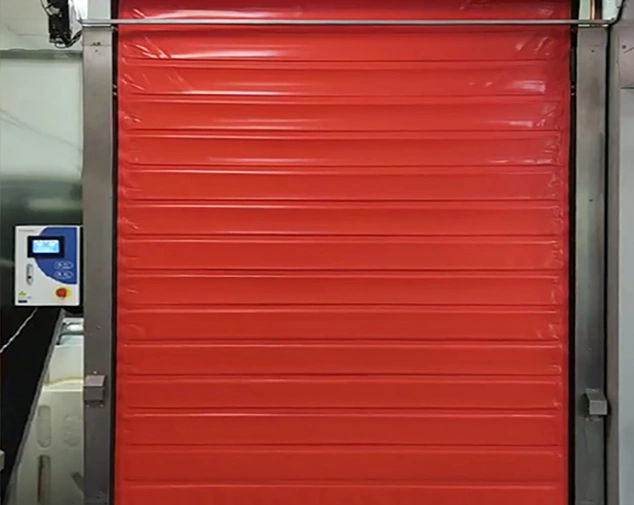
A freezer or low-temperature passage shouldn’t be treated as a normal warehouse opening with a different curtain color. Frequent operation can create heat exchange around the doorway, and moisture can freeze around the guide area.
Cold-storage rapid-door configurations can add insulated curtain structures, low-temperature materials, zipper sealing, and track anti-freezing or heating devices. These features are meant for an environment where reliable movement and temperature separation have to coexist.
That creates a practical three-level decision. A lightly used passage with a moderate temperature difference may still work with pvc strip curtains. A high-traffic temperature-controlled route may justify a powered rapid door. A freezing environment should be evaluated as a cold-storage door project rather than a general warehouse door project.
В холодильное хранение изоляция роликовая жалюз дверь is the relevant product direction when low-temperature operation, track freezing, and thermal separation become part of the requirement.
Safety Works Differently With a Powered Door
A powered door introduces moving equipment into the passage, so the safety system must be specified with the traffic.
GUDESEN rapid doors can use safety photoelectric protection near the lower part of the opening. If the beam detects an obstruction while the door is descending, the controller can stop the closing movement and return the door upward. A safety light curtain provides a larger monitored area by using multiple sensing points along the doorway. Bottom safety devices can also be added on suitable configurations.
This matters in forklift doors because the obstruction is not always a person standing in the center of the opening. A pallet may project beyond the forks. A trolley may stop off-center. A worker may enter from the side.
A single photoelectric point and a multi-point light curtain do not provide the same coverage. Buyers should therefore ask what safety system is standard, what is optional, and what happens when the opening remains occupied.
Maintenance Is a Different Kind of Work
PVC strip curtains have fewer powered components, so routine attention is usually focused on the condition and position of the strips. High speed doors add a motor, control box, encoder, guide rails, switches, sensors, curtain, roller, and other moving or electrical parts.
More components don’t automatically mean the wrong choice. Maintenance has to be judged against the job the opening performs.
For routes where accidental contact is likely, a self-recovery design can change the downtime equation. A zipper-type rapid door allows the curtain to leave the track under impact and return to position during the next opening cycle, reducing the need for a manual reset after some minor collisions.
That feature belongs to a specific structure rather than every rapid door. Buyers who expect frequent contact can review the Быстрая дверь самовосстановления and compare it with a standard PVC configuration.
PVC Strip Curtains vs High-Speed Doors by Operating Condition
| Operating condition | PVC strip curtains | High speed doors |
| Light indoor traffic | Strong fit | May be unnecessary |
| Repeated forklift traffic | Works if the passage remains manageable | Better suited to controlled automatic access |
| Automatic opening | Not applicable | Radar, geomagnetic, button, pull cord, or remote |
| Controlled closing | Passive return only | Timed or controlled closing cycle |
| Basic zone separation | Good fit | Good fit |
| Stronger dust or air-control requirement | Limited by repeated physical passage | Better when full-opening time must be reduced |
| Low-temperature project | Requires suitable curtain material | Dedicated cold-storage configurations available |
| Collision-prone route | Strips can be replaced individually | Self-recovery door can be considered |
The table is not a winner-and-loser scorecard. Warehouse doors should be selected around the opening’s role. A lightly used side passage and a main logistics route should not be specified the same way.
When Does Upgrading Make Sense?
A single issue rarely justifies changing the whole doorway. The case becomes stronger when several conditions appear together: frequent forklift movement, repeated curtain contact, a need for automatic access, temperature difference, dust or odor control, and pressure to close the opening quickly after each passage.
At that point, forklift doors are no longer just a barrier. They are part of the traffic system.
A US factory project illustrates the difference. The requirement was a rapid-closing passage for a new facility where people moved through the opening regularly. A high-speed sealed rapid door was used so the passage could close quickly after traffic cleared, while supporting dust control and separation between areas. The value came from the operating cycle, not from replacing one material with another.
Before ordering, record the opening width and height, daily traffic pattern, vehicle type, indoor or outdoor location, temperature conditions, and preferred trigger method. Those details determine whether a basic curtain, a PVC rapid door, a self-recovery system, or another warehouse door type is the better fit.
Вывод
PVC strip curtains and high speed doors solve different versions of the same access problem. Industrial curtains remain useful when a facility needs simple separation, direct passage, and low system complexity. High speed doors become more valuable when the opening must respond to traffic, close automatically, support environmental control, and coordinate with safety sensors.
The decision should start with the passage. Count forklift movements. Check whether pedestrians share the route. Measure the temperature difference between zones. Look at where vehicles approach and whether accidental impact is likely. Then choose the door structure and activation method around those conditions.
If the opening has already moved beyond simple separation, send the door dimensions, traffic frequency, temperature range, and preferred opening method to request a project-specific door recommendation. That gives the supplier enough information to compare the right high speed doors instead of quoting a generic model.
Часто задаваемые вопросы
Q1: Can PVC strip curtains be used where forklifts pass through?
A1: Yes. PVC strip curtains can work on forklift routes when the traffic level, visibility, and environmental requirements remain manageable. If the route becomes very frequent or needs controlled automatic closing, a high-speed solution may fit better.
Q2: Are high speed doors suitable for cold storage?
A2: They can be, but the configuration matters. Low-temperature projects may need insulated curtain materials, stronger sealing, and anti-freezing or heating measures around the guide system rather than a standard warehouse configuration.
Q3: What information is needed before choosing warehouse doors?
A3: Start with opening width and height, forklift and pedestrian frequency, temperature conditions, indoor or outdoor installation, traffic direction, and preferred activation method. These details help separate a simple partition need from a high-frequency automatic-door project.