




Roller Shutter Parts: Which Ones Actually Wear, and Which to Keep as Spares
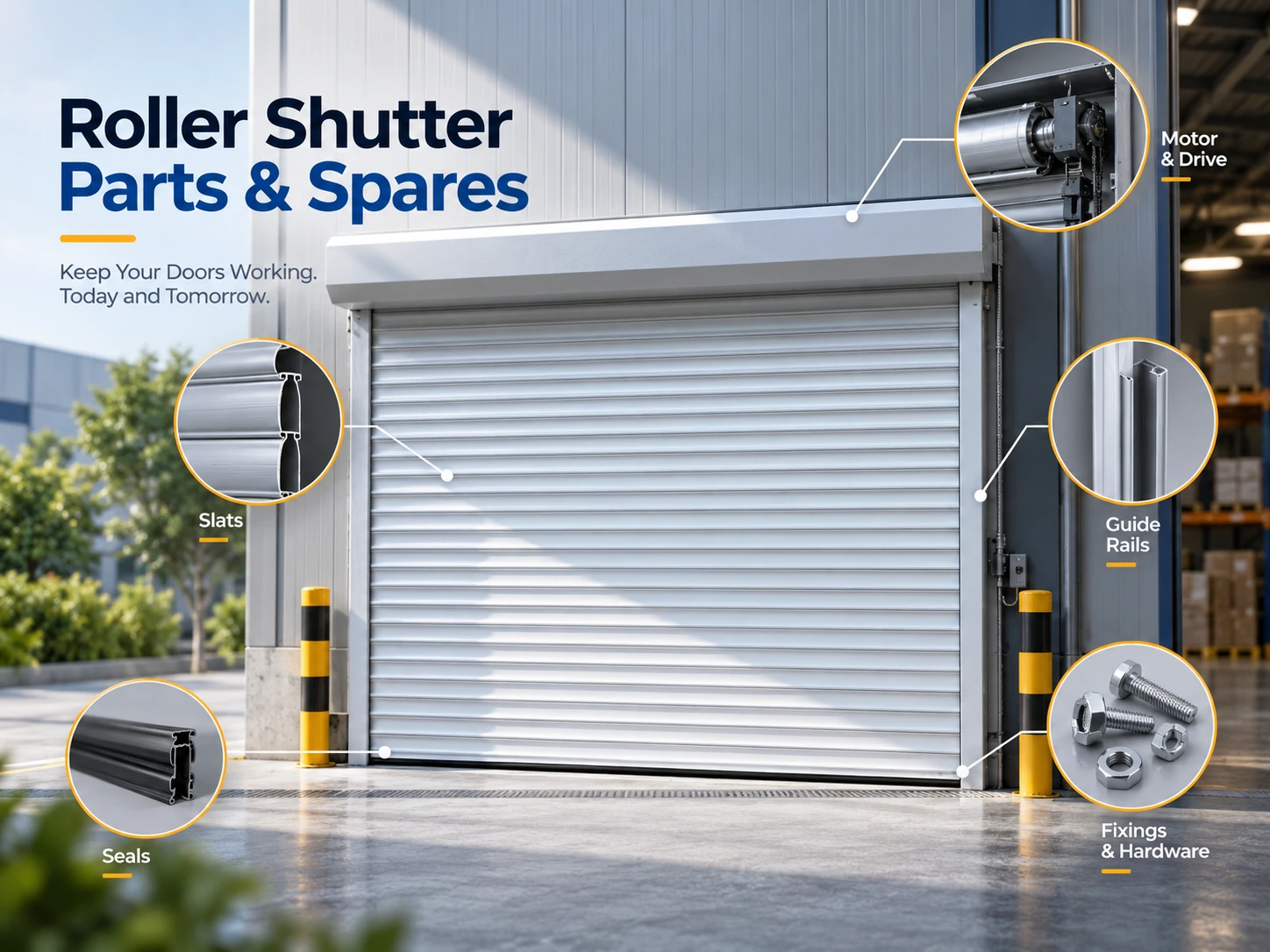
Roller shutter parts are usually ordered in a hurry. A door stops halfway, someone identifies the most visible broken item, and the replacement arrives after the bay has already been standing idle. The better question is asked earlier: which parts of this shutter are designed to wear, which of them can be identified from the door’s own data, and which should already be on the shelf. That turns a parts order from a guess into a decision, and it is the difference between replacing a component and replacing a door.
Why Roller Shutter Repairs Are Usually Parts Problems
The Parts That Decide Whether the Door Opens
A roller shutter is a small system, and each part of it fails for its own reason. The curtain carries the impact and the weather; the hanging plates carry the curtain’s weight; the guides keep it in line; the drive lifts it; the control decides where it stops; and the safety devices decide what happens when something is in the way. A door that will not open is therefore rarely “broken” as a whole. It is one part refusing to do its job, and the useful first question is which of those jobs has stopped being performed. Repair cost is usually dominated by identification time and availability rather than by the price of the component itself.
Manual and Motorized Shutters Do Not Share the Same Parts List
The single biggest source of wrong parts is assuming that two shutters of the same size contain the same components. GUDESEN roller shutters are offered with manual, electric and remote-control opening, and a manual belt drive system is available where a powered operator is not wanted. A belt-driven shutter and a motorized one may share slats, guides and hanging plates, but their drive and control parts are different families. In the motorized state, infrared and resistance-rebound functions can be specified to improve safety and increase service life, which adds devices that a manual shutter does not carry at all. Before any part is ordered, the drive arrangement and the fitted options have to be established, because they decide which parts list applies.
A Parts Map for an Industrial Roller Shutter
Curtain, Slats and Hanging Plates
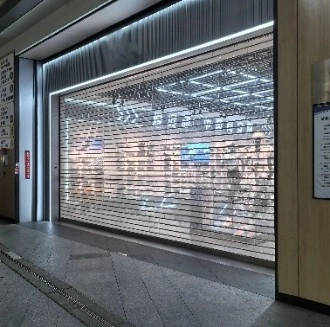
The curtain is where damage is visible, and the hanging plates are where it is often decisive. Slats are refined from high-quality aluminium alloy, and GUDESEN develops its own roller shutter door and window profiles and accessories rather than buying a generic profile set, with a design intended to keep the door starting quickly and operating safely. That matters for parts: profiles and accessories that belong to a specific system have to be identified as such, not by eye. Where the surface has been finished by powder coating, heat transfer wood grain, electrophoresis or anodic colouring, the finish is described as resistant to fading, peeling and yellowing, so a worn patch usually means abrasion or impact rather than a finish failure. On a crystal roller shutter door the curtain is carried on stainless steel hanging plates, described as durable and pressure resistant, with a high-strength polymer material that is documented as resisting aging and deformation – which is why the crystal door is described as easy to clean, maintain and install, and why its plates rather than its slats are the parts to inspect and hold. The aluminium alloy roller shutter door documents the construction the slat and profile parts belong to.
Guides, Brushes and Sealing Strips
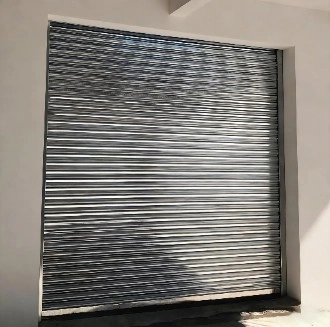
Guides hold the curtain in its plane and take every sideways load. Their wear items are the small ones: the sealing strips and brushes that keep weather and dust out and, in industrial use, the strips on both sides of the guide rail that are documented as giving waterproof, dustproof and shockproof performance on aluminium roller shutter construction. These are consumables in the real sense – they are expected to be replaced – and a door that has started to leak air, water or dust is usually reporting a strip or seal problem rather than a structural one. The production process for aluminium roller shutters uses sound-absorbing strips and sealing codes made from high-quality virgin glue, which is also why a shutter with perished strips runs noticeably louder than it did when new.
Drive, Control and Safety Devices
The drive group is where a parts order most often goes wrong, because the parts are not interchangeable between systems. A belt drive needs its belt, tensioner and hand-wheel parts; a motorized shutter needs the operator, its control panel, limit settings and the release that lets the door be moved when power is not available. Safety devices have their own parts identity as well: where infrared or resistance-rebound protection has been specified, those sensors and their fixings are part of the door’s configuration, not accessories that can be substituted across models. The safest rule is to treat the drive, control and safety group as a matched set and to identify each item by the function it performs. The door fittings range shows the categories – motors, sensors, controls and safety devices – that these parts are ordered from.
How to Identify the Right Part Before You Order
What the Door Data Has to Establish
Identification starts with the door, not with the broken item. Four facts resolve most ambiguity: the shutter type and curtain material, whether the door is manual belt driven or motorized, the opening size and the curtain’s weight or panel specification, and the daily cycle pattern the door works at. GUDESEN matches motor solutions to the door weight and opening frequency the customer provides, which is the same logic a parts order follows: a component is correct only against the door it will move. Photographs of the failed part, the maker’s marks on the motor or control, and any installation documentation all shorten the process. The roller shutter door range sets out the shutter types and materials, which is where that identification begins.
Where a Wrong Part Goes Wrong
A wrong part does not always fail immediately, which is what makes it expensive. A hanging plate from a different profile family may fit the bolt holes and still carry the curtain unevenly, so the guides begin to wear on one side. A sealing strip of the wrong hardness may seal perfectly for a month and then harden and rattle. A control or limit part that is electrically compatible but sets positions differently leaves the door stopping in the wrong place, which then reads as a mechanical fault. The practical test is not whether the part mounts, but whether the door’s behaviour after fitting matches its behaviour when new. If it does not, the part is wrong even if it fits.
What to Keep as Spares, and What to Order Per Event
Consumables Versus Project-Specific Parts
Two categories behave differently. Consumables are used up by normal operation: sealing strips and brushes, bottom seals, fasteners, belt parts on a manual drive, and the small switches and sensors that end a shift when they fail. Project-specific parts belong to the individual door – slats, hanging plates, the motor, the control panel, and any safety device tied to the door’s configuration. Consumables are worth holding on site; project-specific parts are worth identifying and quoting early, even when they are not stocked locally. The worst outcome is discovering, during a breakdown, that a part has to be measured, ordered and shipped while the opening is unavailable. The crystal roller shutter door is a useful illustration of why: its stainless steel hanging plates and polymer material are specific to that construction, so the part identity has to come from the door, not from the shelf.
The Stocking Decision for a Multi-Shutter Site
A facility with several shutters should decide spares at the site level rather than the door level. Group the doors by family – material, drive arrangement and size band – and hold consumables that fit every group, then record which project-specific parts each group needs and how quickly they can be supplied. Doors critical to dispatch or security should have their parts identified in advance even if nothing is held; doors that are rarely used can wait. The question to answer is not “what might break”, but “which opening can the site afford to lose while a part is ordered”. That answer usually shrinks the spare list to a short, practical one.
Ordering Roller Shutter Parts With Confidence
What to Send With the Request
A request that names a part by description alone invites a wrong shipment. The details that make an order correct are the door type and curtain material, manual or motorized operation, the fitted safety options, the opening size and panel specification, the daily cycle count, the environment, and the symptom or failure that prompted the order. Add measurements and photographs of the failed component, plus any identification on the motor, control box or hanging plate. GUDESEN supplies installation files or installation videos and supports installation remotely through its own personnel, so the door’s own documentation can be used to confirm the configuration that the part has to match.
What the Manufacturer Owes You in Support
Parts availability is a service question as much as a catalogue question. GUDESEN develops its own roller shutter profiles and accessories, which is what makes it possible to identify a part against the original construction rather than against a generic equivalent, and its products carry a one-year free warranty with lifetime maintenance. Alongside the part itself, the useful support is identification, lead time and fitting guidance: which component is correct for this door, when it can be supplied, and what has to be checked once it is fitted. Treating a parts order as a small project – data first, then the part – is what keeps a shutter from becoming a replacement.
Conclusion
Roller shutter parts are not a catalogue problem; they are an identification problem. Establish the shutter type, curtain material, drive arrangement and fitted safety options first, because those four facts decide which parts list applies, then order the part against the door rather than against a photograph of a broken component. Hold consumables – strips, brushes, seals, fasteners and small switches – and identify project-specific parts such as slats, hanging plates, motors and control units before they are needed. When the door’s behaviour after a repair does not match its behaviour when new, the part was wrong even if it fitted, and that check is worth keeping in the maintenance record. Sending the door data, measurements and photographs to GUDESEN keeps the order correct the first time.
FAQs
Q1: How do I know which roller shutter parts my door takes?
A1: Start from the door, not the failed item. The shutter type and curtain material, whether the door is manual belt driven or motorized, the fitted safety options, the opening size and panel specification, and the daily cycle count together decide which parts family applies. GUDESEN matches motor solutions to the door weight and opening frequency the customer provides, and the same principle applies to parts: a component is correct only against the door it will move. Photographs, measurements and any marks on the motor or control shorten the check.
Q2: Which roller shutter parts should a facility keep in stock?
A2: Consumables that are used up in normal operation: sealing strips and brushes, bottom seals, fasteners, and the small switches and sensors that stop a door working. Belt parts belong on that list for a manual drive. Slats, hanging plates, motors, control panels and configuration-specific safety devices are usually identified rather than stocked, but they should be quoted and recorded in advance for the doors the site cannot afford to lose. Grouping shutters by family makes the consumable list much shorter.
Q3: When is replacing a part not the right answer?
A3: When the failure keeps returning, or when the door’s behaviour never returns to normal after the part is fitted. A part that fits but changes how the curtain hangs, how the door seals or where it stops is the wrong part, and repeating that cycle damages the guides, the curtain and the drive. If two or three parts in the same system have already been replaced, or if the pit or frame has deteriorated, the decision moves from parts to whether the door still suits the opening it serves.