




Which High Speed Door Sensor Works Best for Forklifts and Pedestrians
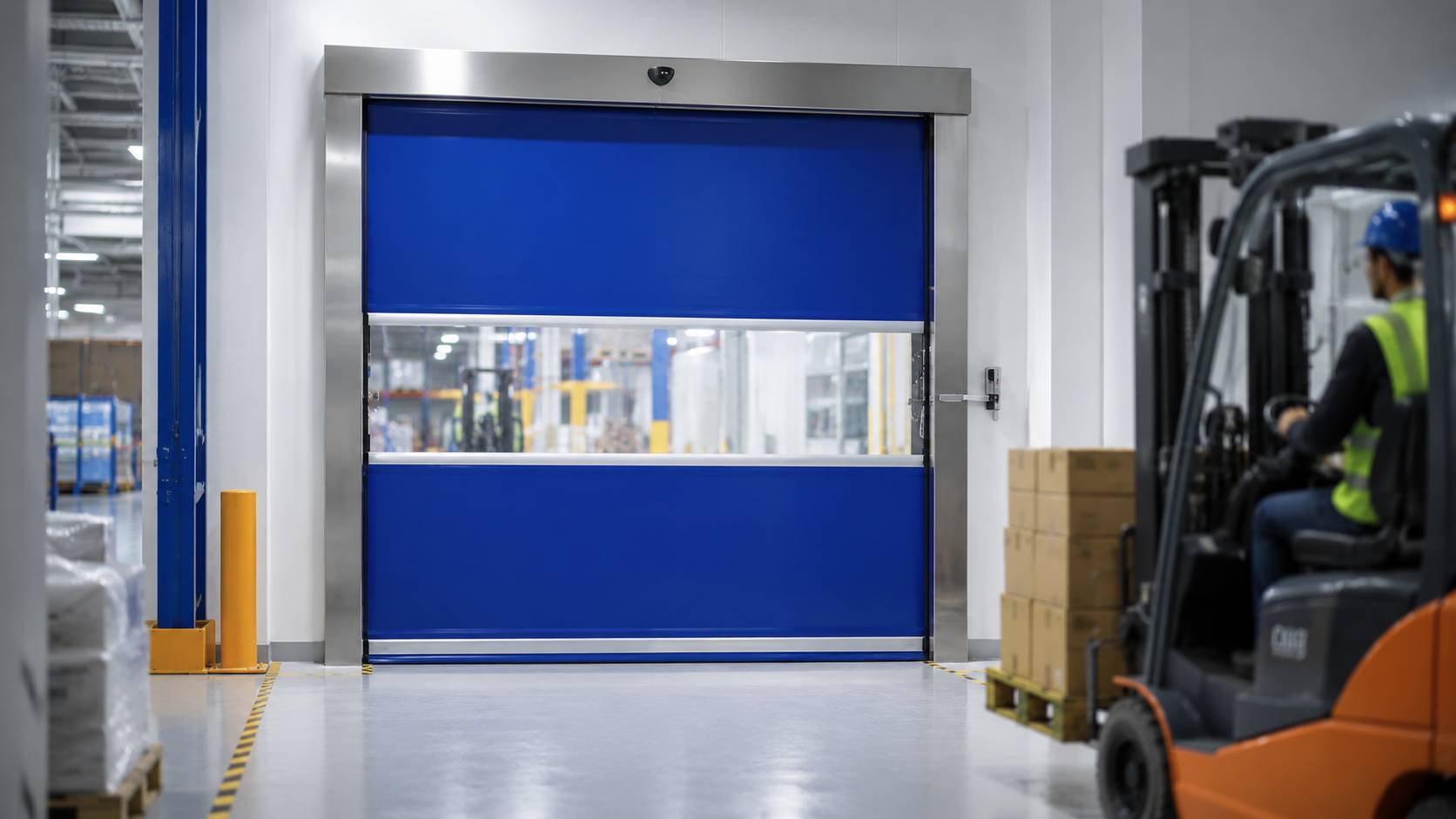
A fast industrial door can open in a fraction of the time required by a conventional shutter, yet speed alone does not create an efficient entrance. The door must open for the right object, at the right distance, and remain open long enough for safe passage. Poor sensor planning often leads to repeated false openings, delayed forklift movement, unnecessary air exchange, or a door that refuses to close.
Selecting a high speed door sensor therefore begins with the traffic pattern rather than a preferred accessory. Forklifts, pedestrians, pallet trucks, and delivery vehicles approach a doorway in different ways. Their speed, direction, stopping position, and metal content affect how reliably a device can detect them. The closing cycle requires a separate safety review because the device that requests an opening may not protect the full doorway while the curtain descends.
A sound specification separates activation from protection. Radar, geomagnetic induction, push buttons, remote controls, and pull-cord switches can send an opening command. Photoelectric beams, light curtains, sensing edges, and airbags help prevent the closing door from striking a person, vehicle, or load. Keeping these functions distinct makes the final configuration easier to test and maintain.
Start With the Traffic Pattern Before Choosing a Sensor
Doorway traffic should be observed during a normal operating shift, not only during a quiet site visit. The review should note who uses the opening, how objects approach, whether they stop inside the doorway, and what moves near the entrance without intending to pass through. These details define the detection zone more accurately than the door dimensions alone.
Forklift-Only Lanes Need Vehicle-Specific Detection
A dedicated forklift lane usually has a predictable approach line. The vehicle may arrive from one direction, slow near the opening, pass through, and continue along a marked route. That pattern suits a detector focused on vehicles rather than every moving person nearby. A geomagnetic loop can be useful where metal forklifts or trucks cross a fixed area in the floor. A pedestrian-vehicle separation radar can instead be configured for vehicle-only detection when the entrance should ignore nearby pedestrian movement.
The detector should trigger early enough for the curtain to clear the forklift mast and load before the vehicle reaches the threshold. Excessive range is not always helpful. A long detection zone may open the door for forklifts travelling parallel to the wall or working in a nearby bay. The site team should confirm the slowest and fastest approach conditions because the same trigger distance may behave differently during loaded and unloaded travel.
Pedestrian Entrances Need Controlled and Predictable Activation
Pedestrians approach less consistently. They can turn, pause, walk beside the doorway, or gather near it. An ordinary radar may respond to both people and vehicles within its sensing area. Where the door should open only for pedestrians, a pedestrian-vehicle separation radar can be configured for pedestrian-only detection. A smaller detection area, a push button, or a pull cord may still provide better control where passage is frequent but organized.
Mixed Traffic Areas Need More Than One Detection Layer
Shared lanes are more demanding because pedestrians and vehicles approach at different speeds and positions. An ordinary radar can activate for either traffic type, while a pedestrian-vehicle separation radar allows the control logic to detect only vehicles or only pedestrians. The safety system should still monitor the opening during closing because activation and anti-collision protection perform different jobs.
How Common Activation Methods Respond to Traffic
Each opening method has a different detection principle. The best option is the one that recognizes intended traffic without reacting to unrelated movement. It also needs to fit the floor construction, approach space, operator habits, and control logic of the facility.
Ordinary and Pedestrian-Vehicle Separation Radar Serve Different Traffic
Ordinary radar can detect pedestrians, forklifts, and trolleys within its sensing area. A pedestrian-vehicle separation radar can be configured to respond only to vehicles or only to pedestrians, depending on the intended lane. Detection distance and sensitivity should be adjusted for the actual approach path, and the sensing field should be tested from several angles rather than only from the center line.
Incorrect positioning may create unstable movement. A sensor mounted or adjusted too close to the curtain can detect part of the moving door, causing repeated opening and closing. Nearby conveyors, swinging materials, or cross traffic can create a similar effect. Reliable radar operation comes from a defined field and a real traffic test, not from maximum sensitivity.
Geomagnetic Loops Focus on Metal Vehicle Traffic
A geomagnetic loop responds to metal within its detection area, so it can distinguish vehicle traffic from ordinary pedestrian movement. This is useful at forklift lanes, vehicle passages, and entrances where workers frequently walk near the doorway without needing it to open. The loop location must match the point where the driver can approach safely and continue without stopping under the curtain.
Push Buttons Remote Controls and Pull-Cord Switches Keep Opening Deliberate
Manual activation remains valuable in controlled passages. Push buttons suit staffed entrances or areas where users can stop safely. Pull-cord switches allow a forklift driver to request opening from a defined position without leaving the vehicle. Remote controls can limit use to authorized operators or designated vehicles.
Activation Sensors and Safety Devices Perform Different Jobs
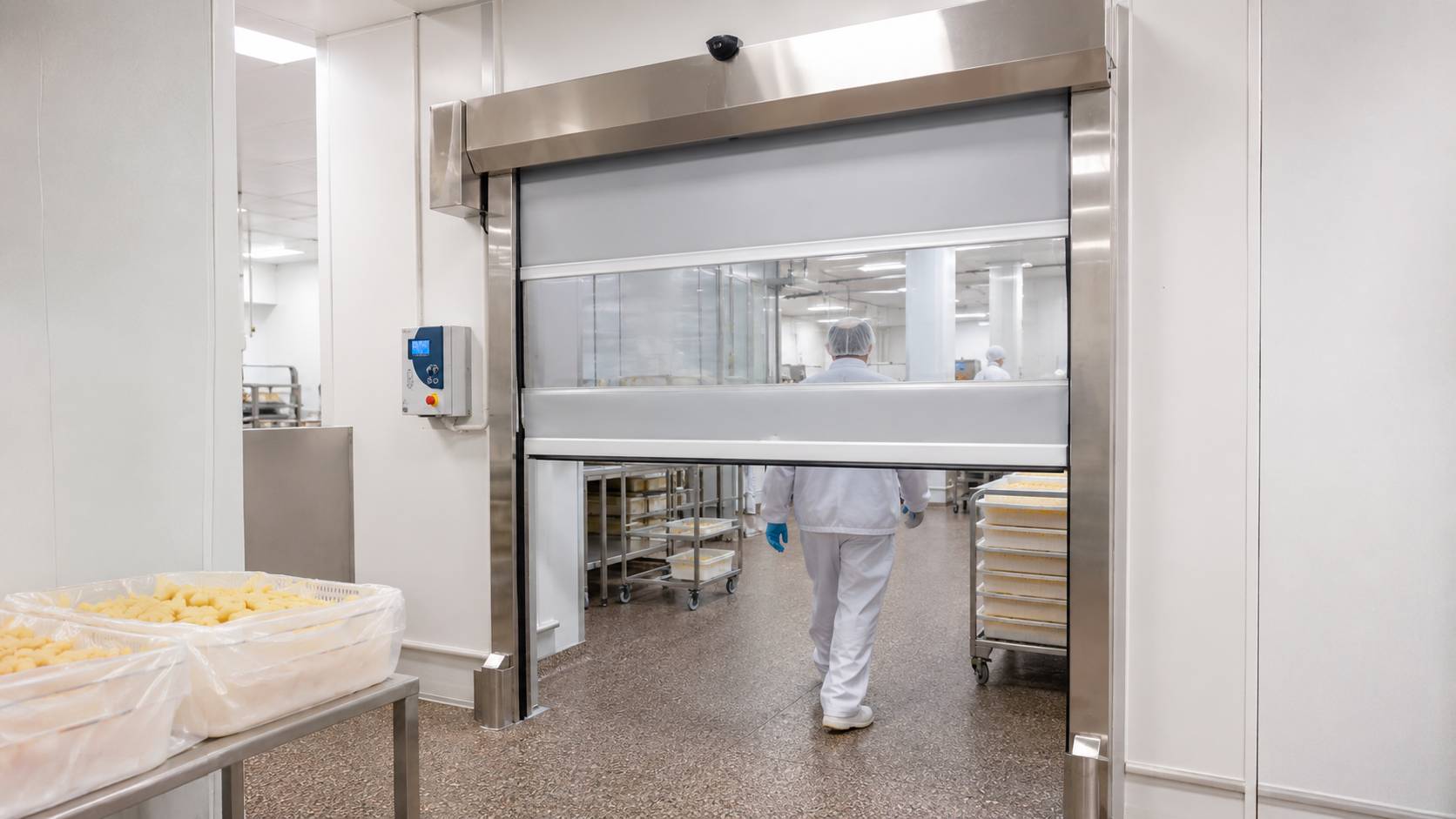
A door can receive the correct opening signal and still close unsafely. The protection system must detect an obstruction during the descent or prevent the curtain from moving into an occupied area. The required coverage depends on traffic density, load shape, stopping behavior, and the acceptable level of residual risk.
Photoelectric Sensors Protect One Detection Line
A through-beam photoelectric device sends a signal between opposite sides of the doorway. When a person, vehicle, or load blocks that line, the controller can stop the descent or return the door to the open position. The device is compact and widely used, but a single beam only protects its installed height. A narrow object outside that line may not interrupt the signal.
Alignment is critical. If the transmitter and receiver shift, the control system may interpret the broken signal as a permanent obstruction and prevent closing. Columns, vibration, impact, dirt, or careless adjustment can affect alignment, so access for inspection should remain available after installation.
Safety Light Curtains Cover a Larger Vertical Area
A safety light curtain uses multiple beams arranged vertically, creating a broader protective field than one photoelectric point. This is valuable where workers, forks, pallet edges, and irregular loads can occupy different heights. A light curtain around 1.8 meters high can monitor much of the lower opening, although the exact device and mounting arrangement should be confirmed for the project.
Safety Edges and Airbags React at the Bottom of the Door
A sensing edge or airbag at the lower part of the curtain responds when the bottom contacts an obstacle. It can add a useful layer behind non-contact detection. Because contact has already occurred, this device should not be the only protection where personnel exposure is significant. It works best as part of a package that also monitors the doorway before contact.
Prevent False Opening and Unstable Door Movement
Commissioning should reproduce normal traffic from every practical direction. Ordinary radar should be checked for nearby pedestrian and vehicle movement, while a pedestrian-vehicle separation radar should be tested to confirm that its selected vehicle-only or pedestrian-only mode does not respond to the other traffic type. Geomagnetic loops should be tested with the smallest and largest vehicles expected on site. Buttons and pull cords should be reachable without placing a user in the door travel zone.
Apply the Product Configuration to Real Door Conditions
For indoor production, logistics, food handling, packaging, and warehouse passages, the PVC High Speed Door can be configured with several opening methods, including radar, geomagnetic induction, push buttons, remote control, and pull-cord switches. Its servo-driven design supports adjustable movement, while the safety package can be selected around the traffic risk. Project dimensions and operating conditions still determine the final frame, drive, and protection configuration.
GUDESEN can review door size, approach direction, daily traffic, opening mode, and safety expectations before the control package is finalized. This review is more useful after the buyer provides a basic site drawing or clear doorway photos, since sensor position depends on the surrounding space as much as the door itself.
Choose the Sensor Package Around the Actual Traffic Flow
No single device is automatically correct for every high-speed entrance. Vehicle lanes favor focused detection, pedestrian passages need controlled activation, and mixed traffic requires separate layers for opening and closing safety. A suitable high speed door sensor should reduce unnecessary cycling while giving users enough time and protected space to pass.
Before procurement, confirm traffic type, approach direction, door size, daily cycle level, stopping behavior, desired opening height, and the required safety coverage. Buyers comparing additional configurations can review the high speed door range before fixing the specification.
Related industrial door articles can support a broader comparison of control and application issues.
To turn those site details into a workable control package, send the traffic layout and doorway information for a configuration review.
FAQ
Q:What is the difference between ordinary radar and pedestrian-vehicle separation radar?
A:Ordinary radar responds to both pedestrians and vehicles within its sensing area. Pedestrian-vehicle separation radar can be configured to detect only vehicles or only pedestrians, depending on the traffic route and opening requirements.
Q:What is the difference between a photoelectric sensor and a safety light curtain?
A:A photoelectric sensor usually protects one detection line. A safety light curtain uses multiple beams across a vertical area, which gives wider coverage for people, forklifts, and irregular loads.
Q:What information is needed before choosing the sensor package?
A:The supplier should receive the door dimensions, traffic type, approach direction, daily opening frequency, vehicle size, pedestrian use, stopping position, nearby movement, and preferred opening method. Site photos or a layout drawing improve the review.