




Overhead Coiling Door: What to Specify for Industrial Duty
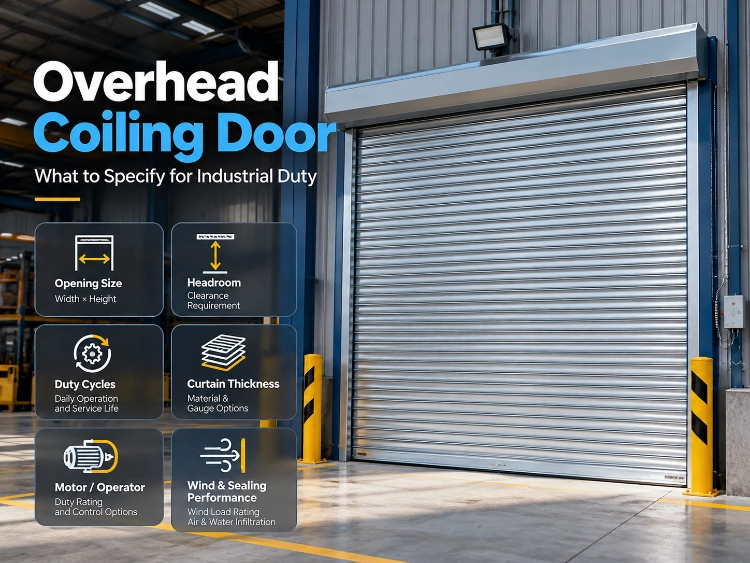
A coiling door inquiry went out with five fields left open, for an opening 4.2m wide by 4.5m high on a bay running about sixty cycles a day between the yard and the warehouse floor.
Three quotations came back at three different prices.
The duty level moved one price. The curtain material moved another. The space above the opening is where a quotation can fail before price matters at all, and each of the five fields is a decision the specifier owns.
What the Opening Decides
The Opening and the Space Above It
A coiling door gathers its curtain into a coil above the head of the opening, and that coil needs room. Measure the structural opening at four points: width, height, side to side, and floor to lintel underside.
Three numbers follow: the space above the lintel, the side room at each jamb, and the material behind the guides. That bay carried a steel beam above the opening, which the coil had to clear. That single dimension can rule a quotation out.
Duty Follows Cycles per Day
Sixty cycles a day is not the same door as six. A factory asks about duty first, because it decides what the door is built from.
Duty follows the opening rather than a catalogue range. Cycles per day set the curtain gauge, the springs and the operator, and those three set the thickness and the motor rating. On its automatic stainless steel security shutter door, GUDESEN lists curtain thickness from 0.6mm to 1.0mm and a standard motor of 450–530W. Those figures belong to that model.
Wind Load and Position
An exterior bay takes wind on the curtain, and the requirement changes with height and exposure. GUDESEN lists a windproof function on that security shutter door, so the wind figure goes in beside the opening size.
Inside a building the wind question disappears. Sealing takes its place once the door separates two environments.
Curtain, Material and Counterbalance
Slat Profile and Material
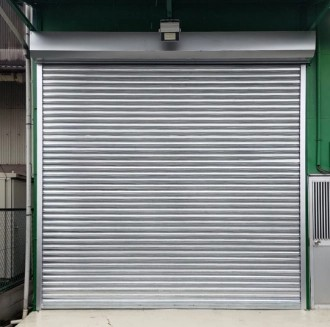
The curtain takes the wear, so the environment picks the material. GUDESEN’s colour steel painted rolling door combines pre-painted colour steel, interlocking galvanised steel slats and a baked paint finish. That combination suits a dry industrial bay.
A shopfront that needs visibility suits the crystal roller shutter door, built from stainless steel and polycarbonate panels. An opening between two controlled environments suits the insulated industrial panel, a 40mm to 50mm polyurethane core with a vinyl seal at the edge.
Three lines cover the curtain in the inquiry: material, thickness and finish. The factory quotes against each one.
Springs Carry the Curtain
A coiling curtain is heavy. Springs carry the curtain weight. The motor lifts the remainder. Spring sizing starts from one figure, the curtain weight, which builds up from the opening size, the slat profile and the material chosen.
Change the material later and the spring specification opens again. A heavier curtain on the same springs raises the effort the operator applies, so a material change after the quotation sends the spring and operator figures back for another round.
Guides, Jambs and the Installation Detail
The Jamb Detail the Installer Needs
A jamb drawing carries four things: the jamb face, the clear opening, the guide position and the fixing points, all with dimensions.
That drawing gets requested by name, which is why manufacturers publish jamb details. Ask for it before the steel goes up. A guide fixed to a poor surface leaves a problem no adjustment solves.
What the Site Needs Before Delivery
Three site conditions go on the checklist before the door ships: the fixing surface, the floor line, and the power feed.
The floor line matters, because a curtain meets a rising slab on the way down. The power feed matters as well. Fix the control point, and check that the cable route reaches it, since a powered coiling door runs from a switch or a remote.
Operator, Controls and Handover
How the Door Is Operated
GUDESEN lists remote control with a wall switch on the security shutter door, and remote control or switch operation with a high-torque, low-noise motor on the crystal roller shutter door. Two answers settle the operator on a loading bay: who opens the door, and from where.
A forklift driver wants the door moving as the truck pulls in. That points at a remote control or a ground loop. Two shifts sharing one bay point at one clearly labelled control point.
The Check Before Sign-Off
The handover check runs through one cycle. The curtain reaches both limits and stops square. The guides hold it without binding. The control point ends up where the bay’s operator stands. Confirm whether the opening needs a safety edge. If one is fitted, check that it reverses the door on contact.
Ask for the settings page with the door. It carries limit positions, spring balance, operator settings and the maintenance interval the manufacturer specifies. That page keeps the second year of a sixty-cycle door running like the first.
GUDESEN builds roller shutter doors and overhead lifting doors. A coiling specification belongs with the roller shutter door family, where the material and finish options are listed. For an aluminium curtain, the aluminium alloy roller shutter door covers the options. An opening with no room for a coil suits the industrial overhead lifting door range.
Conclusion
A coiling door quotation answers a specification, and that specification starts at the opening. The space above the lintel decides whether a coil fits. The cycles per day set the duty. The environment sets the curtain material, the spring balance and guide fixing. With those decisions in the inquiry document, three prices describe one door.
FAQs
Q1: What decides the coil clearance above an overhead coiling door?
A1: The coil diameter, which grows with curtain height and slat profile, plus guide clearance and fixing clearance. Measure the space above the lintel before choosing a door. A beam in that space removes the coil’s room.
Q2: What decides the duty level of a coiling door?
A2: Cycles per day, and the curtain weight that follows. Sixty cycles a day wears springs, guides and operator far faster than a few openings a shift. Duty sets the curtain gauge, the spring balance and the operator before a model is named. GUDESEN lists 0.6mm to 1.0mm curtain thickness on its automatic stainless steel security shutter door. Those figures belong to that model.
Q3: Which curtain material suits an industrial opening?
A3: The environment decides it. Dry industrial bays take pre-painted colour steel with interlocking galvanised steel slats. Openings that need visibility take stainless steel with polycarbonate. Openings between two environments take an insulated polyurethane-filled panel.