




Solving High-Span Opening Challenges with Flexible Access Doors
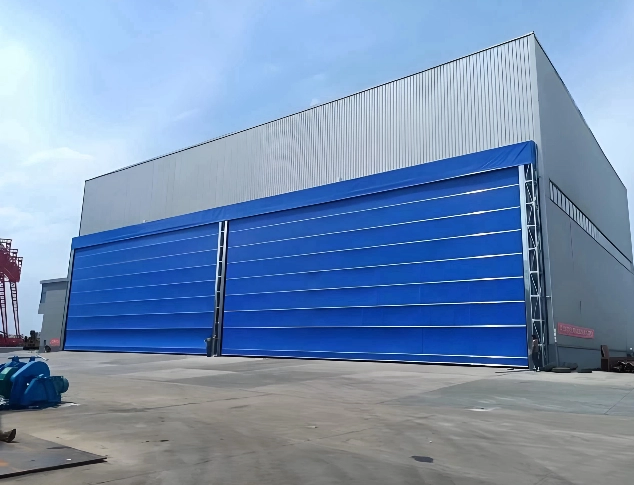
Imagine standing inside a massive aircraft hangar designed to house a Boeing 777 or a modern rocket assembly line. These structures are engineering marvels, but they present a massive headache for facility managers: how do you close a hole that is 50 meters wide and 20 meters high? Traditional rigid doors simply cannot handle these dimensions without becoming impossibly heavy or requiring massive tracks that eat up valuable ground space. In the world of modern aviation and heavy industry, the “bigger is better” trend in machinery means we need smarter ways to seal our workspaces.
The answer has evolved from weighty metal sheets to advanced, light fabric arrangements. Employing a professional flexible access door goes beyond mere choice; it becomes essential for preserving inside temperatures and safeguarding valuable assets worth billions. Whether facing seaside storms or the precise environmental standards of a sterile room workspace, comprehending the workings of these expansive barriers marks the initial move toward a more productive site.
Why Traditional Rigid Doors Fail at Massive Scales
When a doorway stretches across a huge span, the laws of physics start to work against standard construction. Most people are used to seeing heavy steel rollers or sliding panels, but once you get past a certain width, these systems become dangerous and expensive. A rigid door that wide requires a foundation and a roof structure so strong that the cost of the building doubles just to support the weight of the entrance.
Transitioning from small-scale thinking to industrial-scale engineering requires a look at how weight and wind interact. If you try to use standard logic on a large span opening, you will likely run into structural fatigue or mechanical failure within the first year. Let’s look at the specific reasons why rigid systems are being replaced by the flexible lift door in modern design.
The Problem of Excessive Roof Loading and Weight
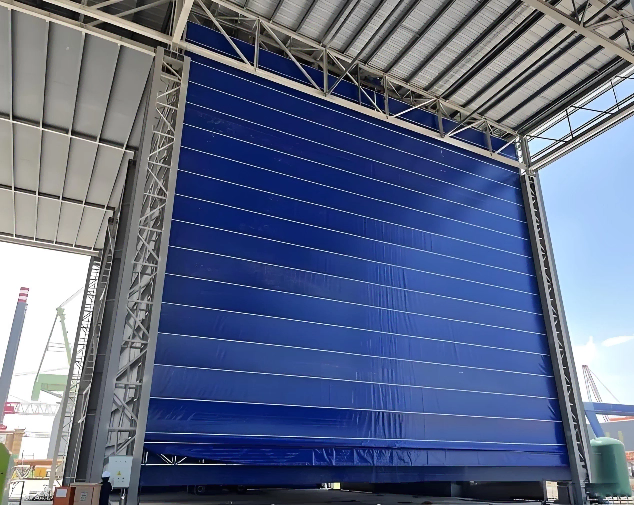
A solid metal door covering a 30-meter span can weigh several tons. This weight puts a massive amount of stress on the top frame of the building. To keep the roof from sagging, engineers have to use significantly more steel, which drives up construction budgets by millions of dollars. GUDESEN’s flexible access door solves this by using a double-layer polyester fabric. Because fabric is much lighter than solid steel, the building’s skeleton does not need to be nearly as beefy. This “lightweight” approach reduces the total weight requirement for the top frame, allowing for more creative and cost-effective architectural designs without sacrificing any protection from the elements.
Space Constraints and the Death of Ground Tracks
Traditional sliding doors need “pockets” or long tracks on the side of the building to slide into. If your hangar is 60 meters wide, you might need another 60 meters of empty land just to open the door. In busy logistics parks or crowded airports, that land is far too valuable to waste. A flexible lift door moves vertically, stacking up neatly at the top of the opening. It does not occupy any indoor or outdoor ground space. This vertical stacking allows for a much tighter building layout, meaning you can fit more hangars or warehouses into the same plot of land, which is a major win for operational ROI.
The Engineering Behind High Wind Resistance
One of the biggest fears facility managers have is a storm blowing their doors right off the tracks. In coastal areas or open airfields, the wind pressure can be staggering. A large span opening acts like a giant sail, catching every gust of wind. If the door is not engineered for these specific loads, it can bend, crack, or even cause a total structural collapse of the building.
Designing for these conditions involves more than just using “stronger” materials; it requires a smart mechanical layout. By integrating internal skeletons and specialized guide systems, modern hangar door systems can stand up to extreme weather that would buckle a standard industrial gate.
Aluminum Beams and Internal Skeletons
To achieve high wind resistance, the door fabric is not just a loose curtain. Between the two layers of polyester cloth, we place horizontal aluminum beams. These beams act as a windproof skeleton. By adjusting the thickness of these beams and how far apart they are spaced, GUDESEN can customize a door to resist almost any level of wind pressure. For example, some turbine-style rigid doors can handle winds up to level 12, but for much larger openings, the aluminum-reinforced flexible system provides a better balance of strength and flexibility. The beams transfer the wind load directly to the vertical guide rails, keeping the door stable even during a violent storm.
The Role of Movable Guide Rails in Wide Spans
For an aperture of truly grand scale, such as 100 meters broad, even the sturdiest aluminum beams could hit their boundaries. Here, the ingenuity of adjustable guide rails proves vital. Rather than constructing a single enormous 100-meter door, we segment the distance into multiple lesser parts. These rails avoid permanent fixation; they lift aside after the door sections ascend. This permits the full barrier to split into separate stacking units. When transporting a compact vehicle, you activate one segment. For a large plane’s entry, you elevate all segments and shift the rails, thus freeing the whole broad span opening within moments.
Specialized Needs: Aviation and Cold Storage
Every industry has its own “pain points.” For an airport, the main concern is often safety and the ability to fit aircraft with different tail heights. For a pharmaceutical or food processing plant, the focus is on sealing and temperature control. A high-quality aviation access door must be able to handle hierarchical top beams—where the roof is not a single straight line but follows the shape of an airplane’s fuselage.
Transitioning into these specialized fields requires more than just a big door; it requires a system that can adapt to the environment. The materials used must be able to withstand UV rays, prevent mold, and keep the indoor climate stable regardless of what is happening outside.
Tailored Solutions for Hangar Door Systems
Current hangar door systems frequently install in settings featuring “hierarchical” upper beams. This indicates the aperture’s top holds an uneven profile. As the flexible access door consists of fabric and aluminum beams, it shapes to match these intricate forms exactly. Such design guarantees a secure closure along the full edge, crucial for upholding the site’s inner atmosphere. Moreover, the dual-layer fabric affords strong noise reduction and fire resistance. Be it a rocket production site or a personal aircraft shelter, the door integrates as a core element of the site’s environmental management and protection measures.
Comparison with Insulated Steel Doors
While the flexible lift door is the king of massive spans, it is often compared to insulated steel doors used in smaller industrial or residential settings. For smaller openings, like a 5-meter wide warehouse entrance, insulated steel doors are fantastic. They offer a solid polyurethane core and 0.4mm thick steel plates for maximum security and thermal efficiency. However, once you cross into the 15-meter or 20-meter width range, steel becomes too cumbersome. GUDESEN provides both solutions, allowing you to use a flexible system for your main hangar and high-quality steel sectional doors for your smaller service entrances or residential garage areas.
Safety Features That Protect Your Assets
When you are moving a barrier that covers several hundred square meters, safety is the number one priority. You cannot afford a mechanical failure when a multi-million dollar aircraft is parked underneath. Industrial environments are busy, with forklifts, tugs, and personnel moving constantly. A “dumb” door is a dangerous door.
Modern systems are built with multiple layers of protection. From mechanical locks to electronic sensors, every part of the system is designed to fail “safe.” Let’s explore the standard safety kit that comes with a high-end flexible access door.
Anti-Breaking Locks and Fall Protection
The most critical safety feature is the anti-breaking lock. If a wire rope accidentally snaps, this mechanical device immediately clamps onto the guide rail, stopping the door from falling at any point. Similarly, the movable guide rails are equipped with their own fall arrest systems. This ensures that even in the rare event of a total power or mechanical failure, the door will not drop. GUDESEN also integrates safety light curtains and infrared sensors as standard. These sensors create an invisible wall; if anything blocks the beam, the door automatically stops or reverses its direction, preventing any contact with vehicles or people.
Conclusion
Building a facility with a large span opening used to be an engineering nightmare. You had to choose between a massive, expensive steel structure or a door that was difficult to operate and maintain. Today, the flexible access door has changed the game. By combining lightweight materials with movable guide rails and high wind resistance engineering, we can now seal even the most massive hangars with ease. These systems save on construction costs, protect against extreme weather, and provide a level of safety that traditional doors simply cannot match. If you are planning a new aviation or industrial project, don’t settle for outdated technology. Please contact us and find a custom solution that fits your exact needs.
FAQs
Q: Can a flexible access door handle very high winds?
A: Yes, by using internal aluminum beams and movable guide rails, these doors achieve high wind resistance even in coastal areas.
Q: Are hangar door systems suitable for rocket assembly buildings?
A: Absolutely. The flexible lift door is perfect for ultra-high openings, providing waterproof, flame-retardant, and sound-insulating protection for sensitive aerospace projects.
Q: How does a flexible door compare to insulated steel doors?
A: While insulated steel doors are great for smaller entrances, the flexible access door is far superior for a large span opening.